AIMS Corp

Blog

  • Portable Generator vs. Inverter System: Choosing Reliable Backup Power

    Portable Generator vs. Inverter System: Choosing Reliable Backup Power

    The Short Answer: A portable generator makes AC power by burning fuel to run an engine, so it keeps producing energy as long as you feed it gasoline, propane, or diesel. An inverter system makes AC power by pulling from a battery bank, so it runs silently with no fuel and no emissions until the batteries drain, then recharges from solar, shore power, or a generator. 

    When grid power fails, whether from a storm, an overloaded line, or planned maintenance, a business needs a backup source that fits the job in front of it. A portable generator and a battery-based inverter system both deliver backup power, but they work in different ways, and each suits a unique set of conditions. Knowing how each one produces power, what it costs to run, and where it performs best is what separates a backup plan that holds up from one that leaves equipment down at the worst time.

    How a Portable Generator Makes Power 
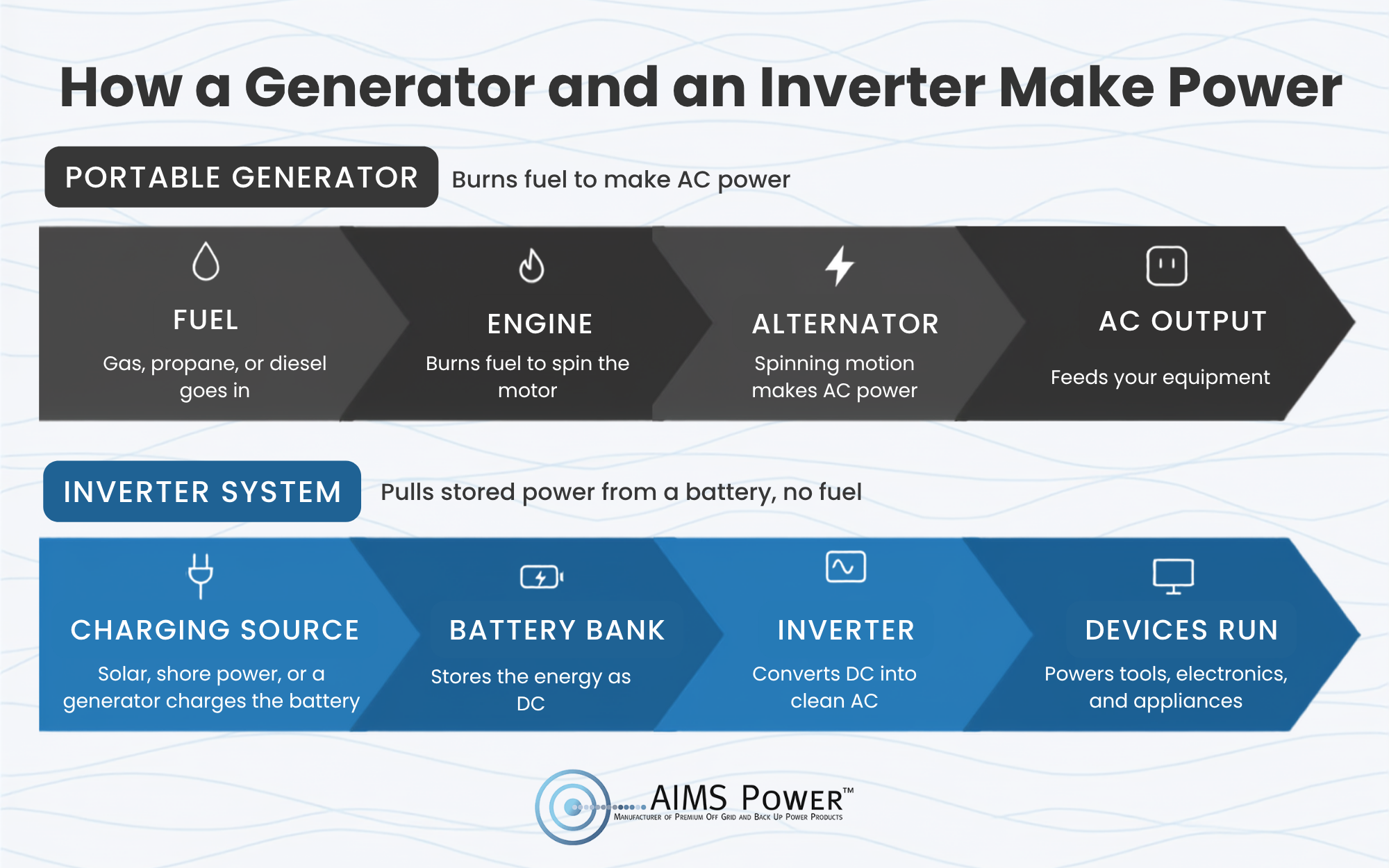
    The engine converts fuel into mechanical energy, and the alternator turns that mechanical energy into electrical energy. A generator burns fuel to turn an engine, and that engine spins an alternator that produces AC power. How the unit manages engine speed is what splits generators into two types.

    Conventional Generators

    A conventional generator, sometimes called a traditional or regular generator, runs its engine at a constant speed, usually around 3,600 rpm, to hold a steady 60 Hz output. The engine holds that speed no matter how light the load is, which raises fuel consumption at low draw and pushes up the noise level. The electrical output also carries more total harmonic distortion, often well above 5%, which is acceptable for a construction site running power tools but rough on more sensitive electronics.

    Inverter Generators 

    An inverter generator still burns fuel, but it converts the engine’s raw output to DC and then back to clean AC through an inverter. This lets the engine adjust its speed to match power demand instead of holding a constant speed, which improves fuel efficiency and reduces noise. Many inverter models offer dual fuel operation and electric start. They deliver cleaner power than a conventional unit, though they cost more up front and top out at a lower power output than large conventional gasoline generators.

    How an Inverter System Makes Power 

    An inverter system stores energy in a battery bank and uses an inverter to turn that DC into AC power on demand. Because a battery-based inverter system does not use a combustion engine, it produces no direct exhaust emissions during operation, runs quietly, and can be installed indoors when the equipment is designed and installed for indoor use. A pure sine wave inverter produces clean power with total harmonic distortion under 3%, similar quality to grid power, which is what sensitive electronic devices and medical equipment need to run safely.

    Runtime depends on battery capacity instead of a fuel tank. When the batteries drain, they recharge from solar panels, shore power, or a generator. Pairing the inverter with solar creates what many call a solar generator, a setup that recharges during daylight and can extend backup power for days without buying fuel. Because the system only draws from the battery when a load is present, it wastes nothing sitting idle, which is better than an engine burning fuel to produce power no one is using.


    Inverter System vs. Portable Generator, Side by Side 

    The easiest way to compare the two is by how they behave during an actual power outage.


    Inverter System

    Portable Generator

    Power quality

    Pure sine, THD under 3%

    Clean on inverter type, higher THD on conventional

    Noise level

    Silent

    Loud to moderate

    Emissions

    None, safe to run indoors

    Carbon monoxide, run outdoors only

    Maintenance

    Minimal, no engine

    Regular engine and fuel service

    Running cost

    No fuel, lower over time

    Ongoing fuel plus upkeep

    Runtime

    Until batteries drain, then recharge

    As long as fuel is available

    Best for

    Clean power, indoor and quiet sites, frequent outages

    Long remote outages with high draw

    Matching Backup Power to the Application

    The right choice comes down to the conditions of the job, not the spec sheet alone. Where the system runs, what it powers, and how long it needs to hold up all shift the decision.
    When an Inverter System Fits

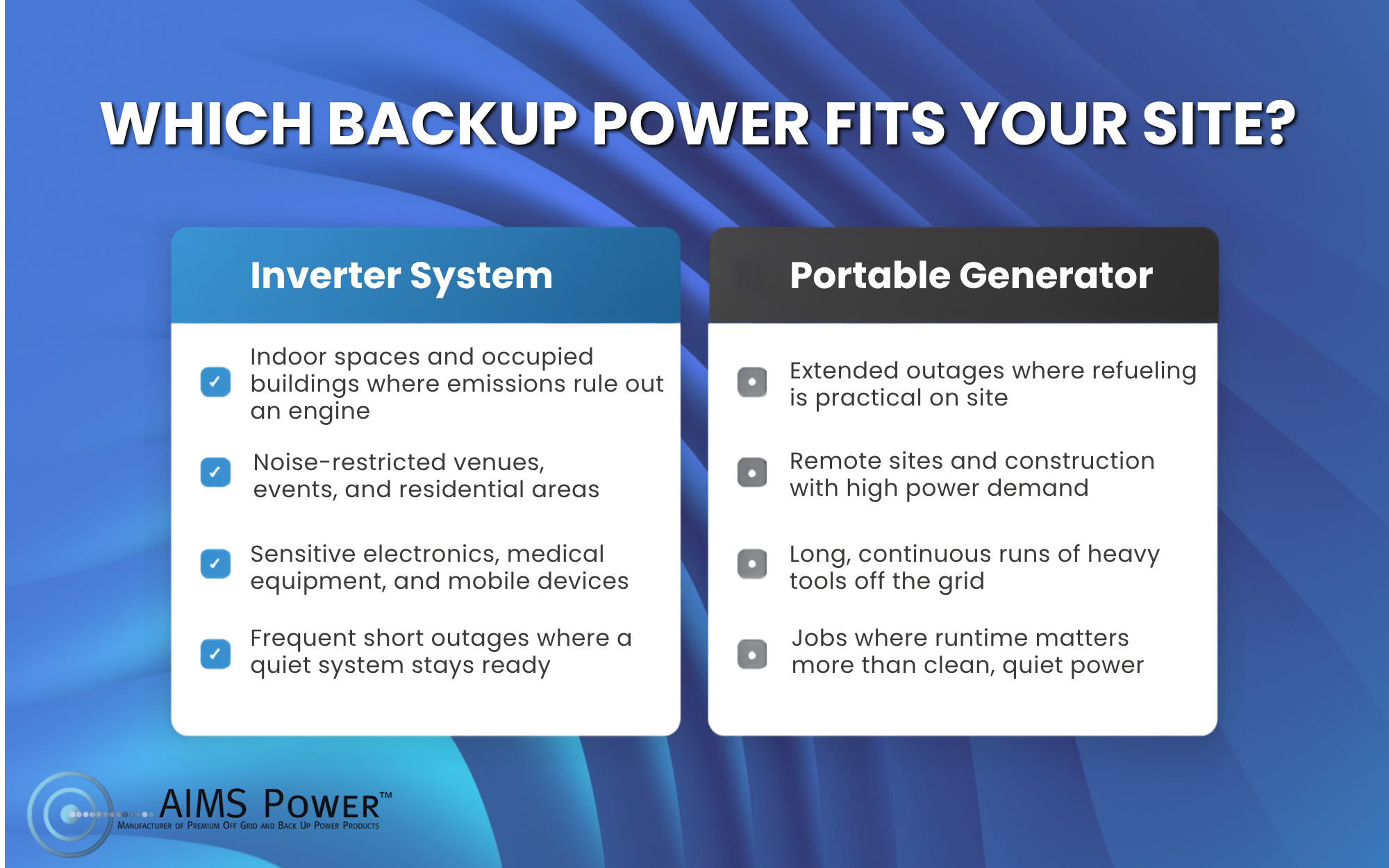
    • Indoor spaces, occupied buildings, and any site where carbon monoxide rules out an engine.
    • Noise-restricted venues, outdoor events, and residential areas that limit generator use.
    • Equipment that needs stable power, including sensitive electronics, medical equipment, and mobile devices that fault on a dirty waveform.
    • Operations that face frequent short outages, where a quiet system that is always ready beats pulling out a generator every time.

    An inverter system paired with a battery bank and solar also works as a standby power source that stays ready without the regular maintenance an engine requires. For a lot of businesses, that covers the majority of what backup power actually has to do.

    When a Portable Generator Fits

    • Extended outages where refueling is practical, and fuel is easy to store on site.
    • Remote job sites running heavy equipment for long stretches, where the draw outpaces what solar can put back during the day.
    • Short winter days, heavy shade, or long overcast stretches, where solar cannot recharge a battery bank fast enough to stay ahead of the load.
    • Long, continuous runs of heavy tools where noise is not restricted.

    A generator’s strength is fuel-fed runtime, which is hard to beat for multi-day work far from the grid. Where that runtime is the priority and clean power is not, it remains the practical pick.

    What Backup Power Costs to Run

    Purchase price is only part of the picture. A generator carries ongoing fuel costs that rise and fall with runtime and fuel prices, plus oil changes, filters, and other regular maintenance to keep the engine reliable. 

    An inverter system usually costs more upfront, but it burns no fuel and needs little upkeep, and adding solar panels lowers the long-term cost further by recharging at no cost during the day. For a business that faces frequent outages, the inverter system’s lower running cost tends to close the gap after a few seasons and then continue the savings after that.

    Build Your Backup Power System With AIMS Power

    AIMS Power is a U.S.-based manufacturer with more than 25 years building power conversion and renewable energy equipment, backed by in-house technical support. For businesses that want clean, quiet backup power without fuel, AIMS builds the full battery-based side of the system: pure sine wave inverters for clean AC output, inverter chargers that combine inversion and battery charging in one unit, deep cycle batteries for storage, and hybrid inverters that fold solar and grid management together.

    If you are specifying backup power for a facility, a fleet, or a product you build, contact AIMS Power to size the right system or to talk through OEM and reseller options. To see the equipment first, browse the full line of AIMS Power inverters and start matching the output to your load.

    Frequently Asked Questions

    Can an inverter system replace a generator for backup power?
    Yes. A pure sine wave inverter paired with a battery bank runs the same equipment a generator would, for hours or days, with no fuel, no noise, and no carbon monoxide. The one place generators still lead is unlimited runtime on long remote jobs, and adding solar panels narrows that gap by recharging the batteries during the day. For frequent short outages, an inverter system usually replaces a generator outright.

    Which produces cleaner power, a generator or an inverter system?
    An inverter system produces cleaner power. A battery-based system with a pure sine wave inverter holds total harmonic distortion under 3%, matching grid quality. Among fuel units, an inverter generator is cleaner than a conventional generator, which runs its engine at constant speed and carries higher distortion, but neither fuel option beats a pure sine inverter for the clean, stable power that sensitive electronics and medical equipment need.

    Can you run backup power indoors?
    Only an inverter system. Because it has no engine and produces no emissions, a battery-based inverter system is safe to run inside an occupied building. Any fuel-burning generator, conventional or inverter type, gives off carbon monoxide and has to run outdoors, away from doors, windows, and vents.

    Do inverter systems need regular maintenance?
    Very little. With no engine, there is no oil to change, no fuel system to service, and no engine wear to track. The main upkeep is keeping the battery bank healthy, and lithium batteries make that easier with long cycle life and built-in battery management. Compared with the routine fuel and engine service a generator needs, an inverter system is close to hands-off.

    How do I size an inverter system for backup power?
    Start by adding up the running wattage of everything you need to power at once. Then check that the inverter’s surge rating covers your highest startup spike, since motors and compressors can pull two to five times their running wattage when they kick on. Finally, match the battery bank capacity to how many hours you need to run between recharges. The AIMS Power Solar Calculator does the math for you. Enter the devices you run in a typical 24 hour period with their wattage and daily hours, and it totals your load and recommends a matching solar kit. For a load that needs a closer look, AIMS technical support can help match the inverter and battery capacity to your actual usage.
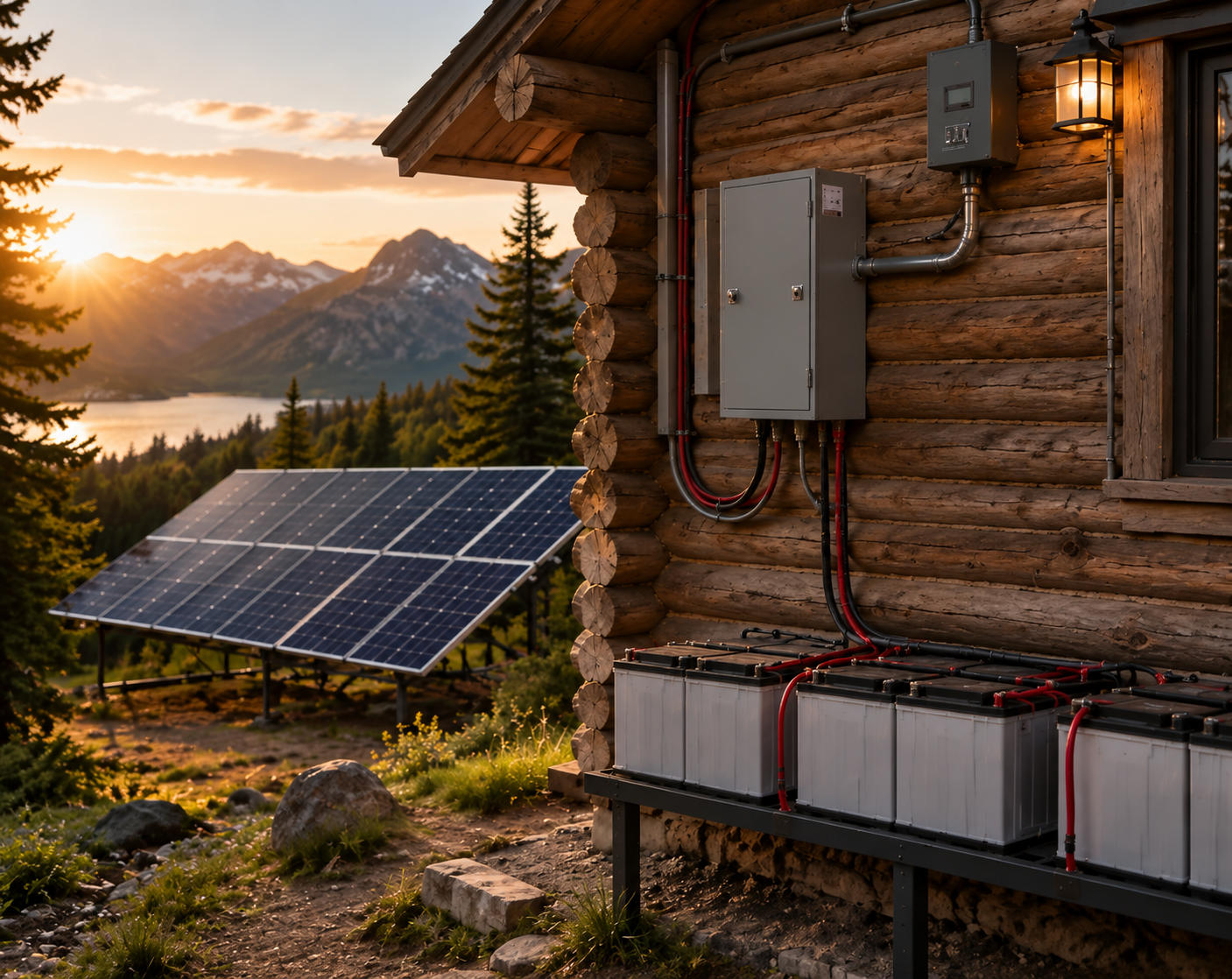
  • 48V Inverters for High Capacity Off-Grid and Backup Systems

    48V Inverters for High Capacity Off-Grid and Backup Systems

    The Short Answer: A 48V inverter converts power from a 48-volt battery bank into the AC power your equipment runs on. Running a system at 48 volts instead of 12 or 24 moves the same wattage at one-quarter the current of a 12V setup, which means smaller cables, less heat, lower installation cost, and room to scale. For high-capacity off-grid and backup power systems, that makes 48V a practical standard once loads and battery banks grow past what a low-voltage system handles cleanly.


    When a power system has to run a whole facility, a large off-grid site, or critical equipment through a long power outage, the battery voltage it is built around matters more than most buyers expect. A 48V inverter sits at the center of that decision. This guide explains what a 48V inverter does, why higher battery voltage helps as systems get larger, how 48V compares to 12V and 24V, and which features to check before you spec one. The goal is a clear path from “why 48V” to a system that delivers reliable power for years.

    What is a 48V Inverter? 

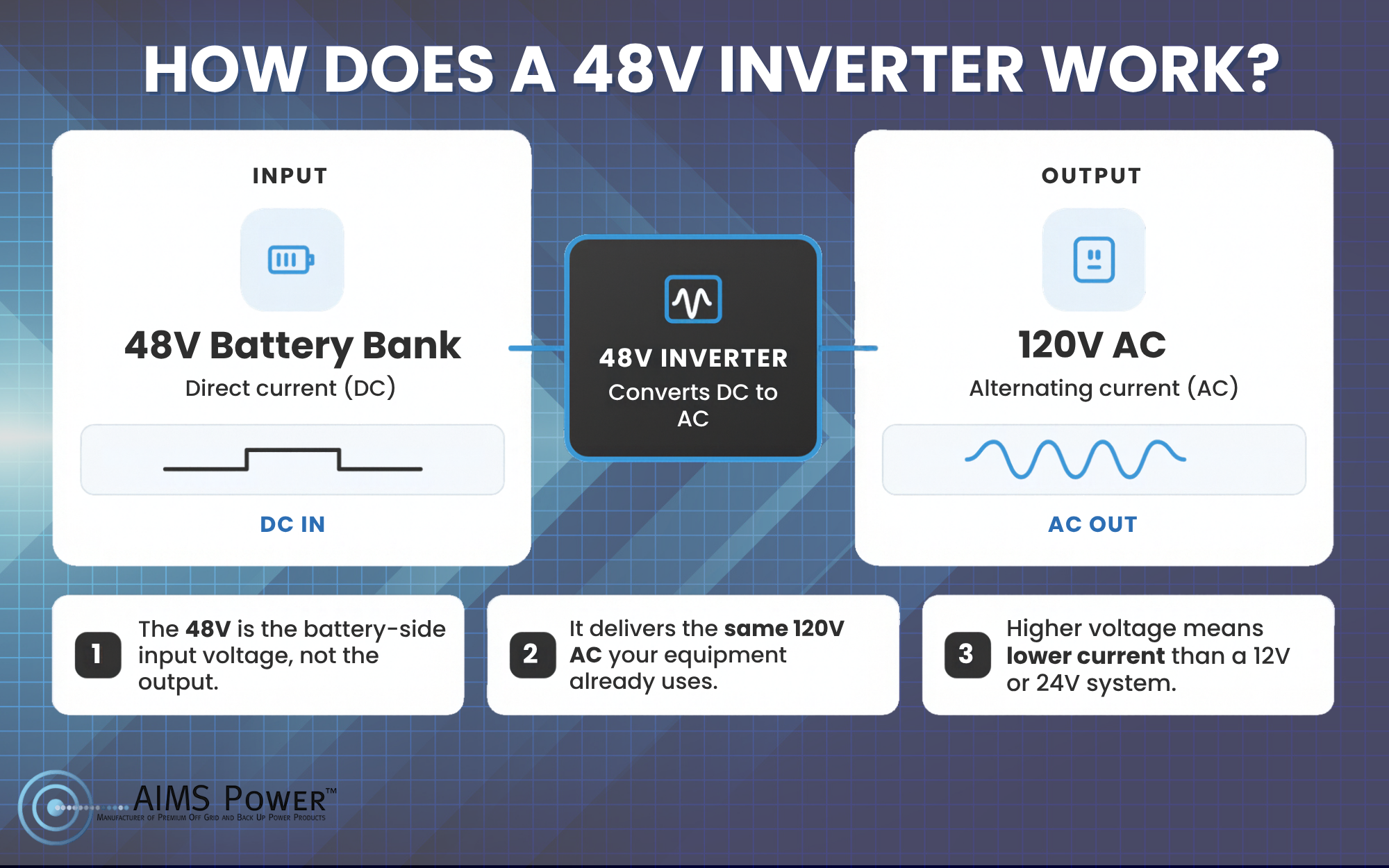
    A 48V inverter is a power inverter that takes direct current from a 48-volt battery bank and turns it into alternating current, or AC power, that standard equipment expects from a wall outlet. The “48V” refers to the input voltage on the battery side. The AC output is the same 120 or 240 VAC your loads already use.

    Every inverter does this DC to AC conversion. What sets 48V inverters apart is the battery voltage they draw from. Because power equals volts times amps, a system built at 48 volts carries far less current than a 12V or 24V system delivering the same wattage. Lower current is the single reason 48V has become the default for larger installations.

    Why 48V for High Capacity Systems? 

    The advantage of 48V is not more power on its own. It is how efficiently the system moves that power. At a given wattage, higher voltage means lower current, and lower current changes almost every part of the build.

    Smaller, Cheaper Cables 

    The amount of current flowing through a wire determines how thick the wire has to be. Higher current needs a thicker, more expensive conductor to carry it safely without overheating. Because a 48V system runs at roughly a quarter of the current of a 12V system for the same load, it needs far less copper, which lowers installation cost and makes the wiring easier to route. 

    Less Heat and Loss 

    Some of the energy moving through a cable is always lost along the way as heat, and that loss grows as the current climbs. A 12V system pushes about four times the current of a 48V system for the same load, so it gives up noticeably more energy warming the wires instead of reaching the equipment. Running at 48V lowers the current, which trims that wasted heat and keeps more of the battery’s power doing useful work.

    Room to Scale 

    Every increase in wattage means more current, and at 12V that current climbs fast enough to become difficult to wire. High performance inverters in the 6,000 to 12,000 watt range are built for 48V because delivering that much power at 12V would call for impractically thick cables and oversized connections. Building at 48V keeps the wiring manageable and leaves room to add capacity later without redoing the whole system.

    Cleaner High Draw Performance 

    Heavy equipment pulls a large spike of power the moment it switches on, often several times its normal running draw. A 48V platform sized with enough surge headroom absorbs those spikes more steadily, so large motors, compressors, and other surge power loads start and run without straining the system. That steadier response is a big part of why high-capacity builds lean on 48V instead of a lower voltage.


    For any system built around a large battery bank and heavy loads, these advantages add up to a setup that runs cooler, costs less to wire, and holds enough headroom to grow as your power needs increase. 

    12V, 24V, or 48V: How Battery Voltage Shapes the System 

    Battery voltage is the first design choice, and it scales with system size. Small mobile and accessory systems stay at 12V, mid-size builds use 24V, and large off-grid and backup systems move to 48V.


    System voltage

    Typical use

    Current at 5,000W

    Best fit

    12V

    RVs, small mobile, accessories

    ~417A

    Small loads, single batteries

    24V

    Mid-size RV, van, small off-grid

    ~208A

    Moderate loads

    48V

    Whole-home backup, large off-grid, commercial

    ~104A

    High-capacity systems, large battery banks


    The pattern is consistent: as the load and battery bank grow, moving to a higher battery voltage keeps the current, cable size, and heat under control. At the top of that range, 48V is what keeps a high capacity system practical to build and safe to run.

    Key Features to Look for in a 48V Inverter 

    Not every 48V inverter is built for the same job. These are the specs that decide whether a unit fits a high-capacity off-grid or backup system. 

    Pure Sine Wave Output 

    A pure sine wave inverter produces AC power with total harmonic distortion under 3%, matching grid quality. That clean pure sine wave output is what sensitive electronics, motors, and medical equipment need to run without overheating or faulting. For any serious backup or off-grid build, pure sine is the standard, not modified sine.

    Split-Phase 120/140V Output 

    Large systems usually need 240V for well pumps, HVAC, and other heavy loads, not just 120V outlets. A split-phase inverter delivers both 120V and 240V from one unit, which is why split-phase 48V inverters are common in whole-home backup and commercial off-grid. If your build has any 240V load, a phase inverter with true split phase output is the piece that runs it.

    Built-In Charging and Solar Input 

    Many 48V units are inverter chargers, combining the inverter and a smart battery charger in one unit. That charger accepts AC input from the grid or a generator to top the battery bank. An all-in-one inverter goes further, folding in a solar charge controller with PV input, the solar input, so solar panels feed the battery bank directly. In that form, the unit works as a 48V solar inverter: a solar charger by day, inverter power on demand, and grid or generator charging as backup. Protection and Monitoring 

    A 48V inverter built for demanding use includes layered protection: temperature protection, short-circuit and overload protection, and an integrated circuit breaker on the AC side. Many units add a remote control panel and Bluetooth monitoring so you can track input voltage, output, and battery state in real time. These features are what keep a high-capacity system safe and easy to service.

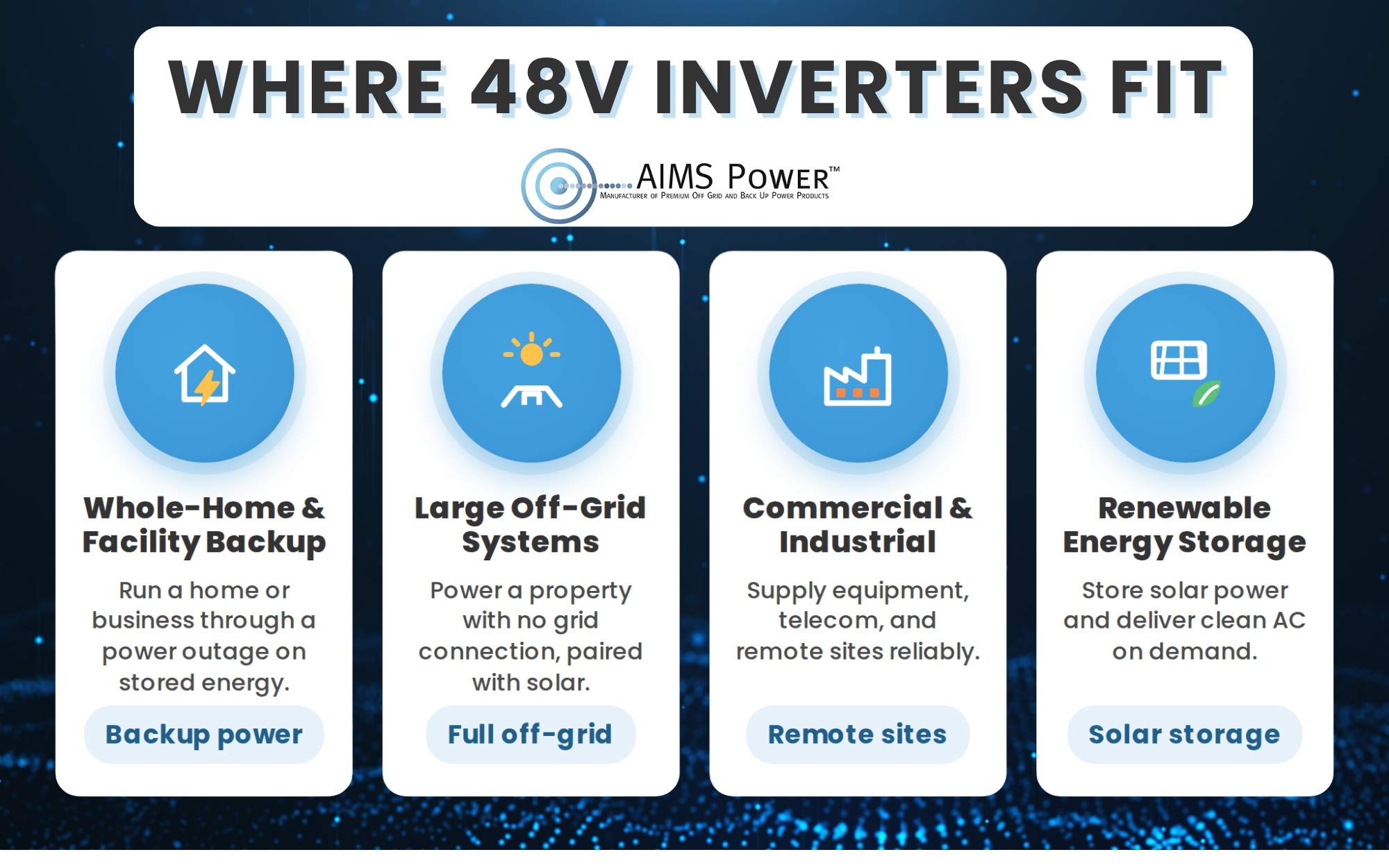
    Where 48V Inverters Fit 

    48V inverters show up wherever a system has to move serious power reliably. 

    • Whole-home and facility backup: Running a home or business through a power outage on stored energy, with a split-phase inverter covering both 120V and 240V loads.
    • Large off-grid systems: Powering a property with no grid connection, paired with a big battery bank, solar panels, and a solar charge controller for full energy independence.
    • Commercial and industrial: Supplying reliable power to equipment, telecom, and remote sites where a low-voltage system would need impractical wiring.
    • Renewable energy storage: Storing solar power in a 48V battery bank and delivering clean AC power on demand as a solar generator.


    In each case, 48V is what lets the system carry a heavy, sustained load without oversized cables or excess heat. 

    Build Your 48V System With AIMS Power 

    AIMS Power is a U.S. based manufacturer with more than 25 years of experience building power conversion and renewable energy equipment, backed by in-house technical support available every business day. AIMS builds the full 48V side of a high-capacity system for installers, dealers, OEMs, and businesses specing power into a facility or a product; that means one source for matched components and the technical help to size them to the load.

    If you are building a high capacity off-grid or backup system, browse the full line of AIMS Power 48V inverters to match the output and features to your load, or contact AIMS Power to talk through a system, an OEM program, or volume options.

    Frequently Asked Questions

    Is a 48V inverter better than a 12V or 24V inverter?
    For large systems, yes. A 48V inverter moves the same wattage at lower current, which means smaller cables, less heat, and lower installation cost. For small mobile or accessory setups, 12V or 24V is simpler and enough. The right choice follows the size of the load and battery bank.

    What size battery bank does a 48V inverter need?
    The inverter needs a 48V battery bank, usually built from lithium or AGM batteries wired to reach 48 volts. Size the bank to how long you need to run between charges, and match the battery chemistry to the inverter’s charger settings. A lithium battery bank gives more usable capacity and longer life for daily cycling.

    Can a 48V inverter run on solar?
    Yes. Many 48V inverters are all-in-one units with a built-in solar charge controller and PV input, so solar panels charge the battery bank directly. This solar charging keeps the system topped off by day and is the basis of an off-grid or backup solar system.

    Does a 48V inverter provide 120V and 240V? Many do. A split phase 48V inverter outputs both 120V and 240V, which is what whole-home and commercial systems need for large loads like pumps and HVAC. Check the spec sheet for split-phase output if your build includes 240V equipment.

    What features protect a 48V inverter?
    Look for pure sine wave output, temperature protection, short circuit and overload protection, and an AC circuit breaker. A remote control panel and real time monitoring help you track battery voltage and output and catch issues early.

  • High Wattage Inverters for Demanding Installations

    High Wattage Inverters for Demanding Installations

    The Short Answer: A high-power inverter converts large amounts of DC battery power into stable AC power to operate heavy loads like commercial equipment, large compressors, and uninterruptible power supply systems. Deploying a power inverter device successfully requires matching the unit’s peak power and continuous power output with an appropriately sized battery bank and correct input voltage. Doing so guarantees high efficiency and stable energy for demanding off-grid, mobile, and commercial applications.

    Demanding installations rarely fail because someone bought a small inverter. They fail because someone bought a big inverter that was still incompatible. A work truck running a rooftop HVAC unit, an off-grid cabin with a well pump, and an OEM building a mobile command vehicle all need a high-power inverter, but the specific power requirements change with each load profile. This guide walks through what “high power” actually means and how to spec continuous and peak power, what to plan for around the inverter itself, and where each type of build tends to land on the AIMS Power lineup.

    What Makes an Inverter “High Power”

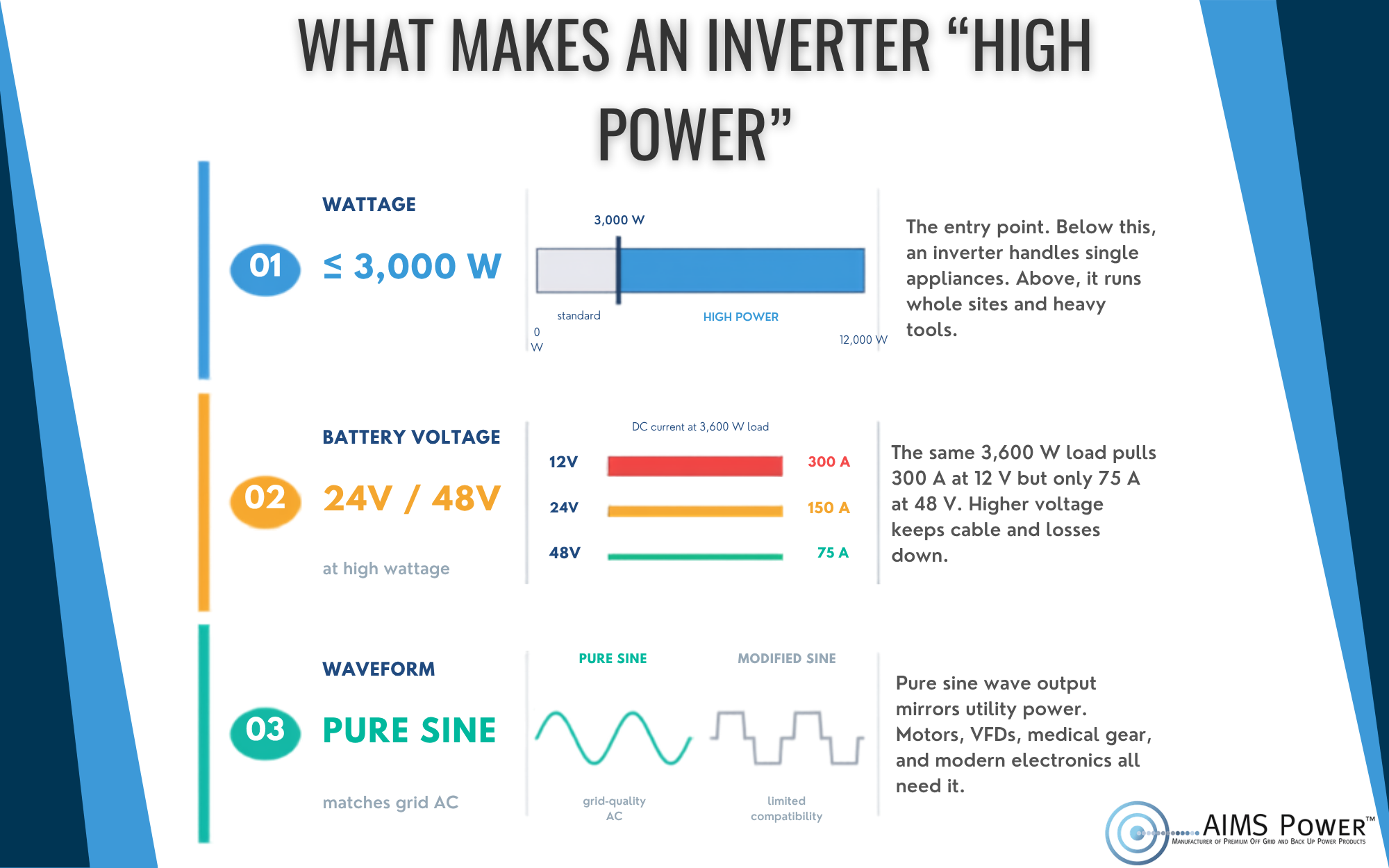
    In power electronics and system design, an inverter rated at 3000 watts of continuous output power or higher falls into the high power category. While lower-wattage units serve intermittent personal electronics or single appliance loads, high-capacity units operate as primary power stations. They provide the necessary maximum power to run everything from residential refrigerators to heavy power tools on a remote job site.

    A high-power inverter must manage massive amounts of current on the DC power side of the system. For example, delivering 3600 watts of AC power from a 12-volt battery bank requires pulling more than 300 amps of continuous DC current. Managing that level of electrical flow generates heat and places immense demand on internal components. Quality high-capacity units use advanced thermal management systems to maintain stability under continuous full-load conditions.

    Continuous Output vs. Peak Power Capacity 

    Every high-load electrical system involves two distinct operational metrics: 

      • Continuous power: The maximum wattage the unit can deliver indefinitely without overheating or triggering safety shutdowns. For reliable long-term operation, your equipment’s peak power demand should ideally fall within the inverter’s continuous power rating to protect the unit from unnecessary strain.
    • Peak Power: the short-duration power output the unit can supply, often for a few milliseconds to absorb the initial inrush current required to start electric motors and compressors. An inverter’s peak power rating is strictly designed for brief surge conditions and should never be relied upon as a sustained operating level. 

    Battery Voltage: 12V, 24V & 48V

    Once you get above about 3,000 watts, 12V systems start to strain. The DC side has to move so many amps that cable size, fuse ratings, and voltage drop become the limiting factors. 24V cuts the current roughly in half at the same power output, and 48V cuts it again. Most high-wattage builds run on 48V pure sine wave inverters for this reason. Higher battery voltage means smaller cable, lower losses, and higher power density in the finished system.

    Where High-Power Inverters Get Used

    The applications look different, but the underlying spec problem is the same. Match a heavy load to a battery power source through an inverter that will not clip, overheat, or shut down mid-shift.

    Work trucks and mobile shops 

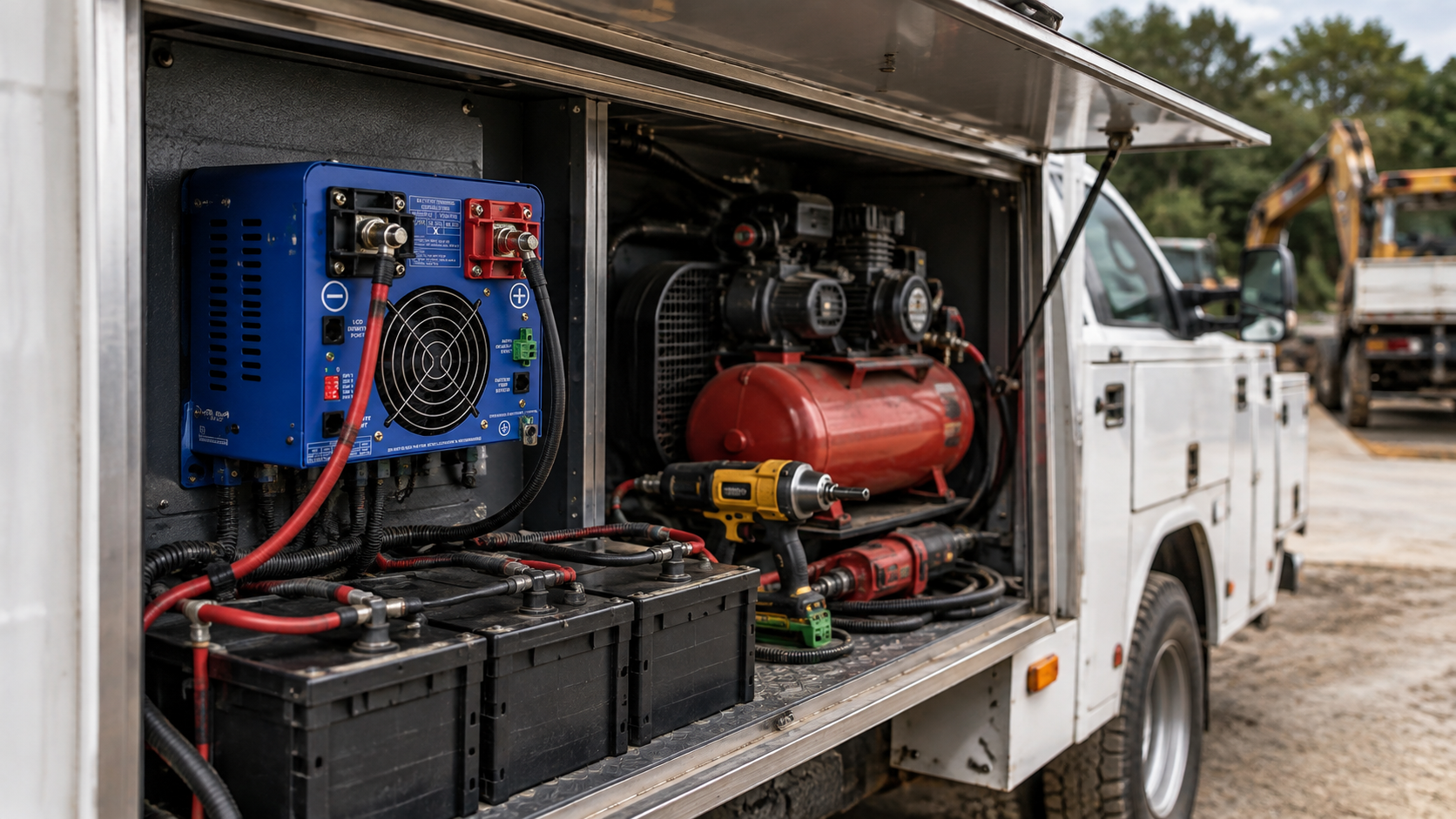
    Utility, service, and mechanic trucks run air compressors, welders, tire machines, and power tools directly from the inverter. A 5,000W or higher unit with a strong surge lets the crew work all day without idling the engine.

    RV, coach, and expedition builds 

    High-end coaches and expedition vehicles run rooftop air conditioning, induction cooking, and residential appliances. A 3,000W to 6,000W pure sine wave inverter charger, paired with a lithium battery bank and solar panel array, replaces shore power for days at a time.

    Off-grid cabins, remote sites, and small solar plants

    A stand-alone home or a small solar plant needs an inverter that can carry the full daytime load and hold overnight loads on battery. 48V pure sine systems in the 6kW to 12kW range are common, often with two inverters stacked for split-phase 120/240V.

    Facility backup and uninterruptible power supply builds 

    A high-power inverter paired with a battery bank acts as an uninterruptible power supply for critical circuits, holding servers, refrigeration, and process control through short outages without the noise or emissions of a fuel generator.

    OEM and industrial integration 

    OEMs and upfitters integrate high-wattage inverters into work vehicles, mobile medical units, broadcast trucks, and portable equipment. The inverter design has to fit the chassis, tolerate vibration, and hold up in the temperature range of the enclosure.

    Waveform Purity: Pure Sine Wave vs. Modified Sine Wave 

    The quality of the AC output waveform dictates how well your equipment functions when operating at high power levels. Inverters generally produce either a pure sine wave or a modified sine wave. The selection directly affects equipment operation and longevity.

    A pure sine wave inverter produces an electrical waveform that mirrors the quality of municipal grid utility power. Clean sine wave power is recommended for microprocessor-controlled equipment, variable-speed power tools, induction motors, and modern appliances with complex digital control boards. Running sophisticated machinery on a pure sine inverter prevents motor overheating, reduces audible humming, and ensures that sensitive electronics perform exactly as the manufacturer intended.

    In contrast, a modified sine wave inverter outputs power in a stepped, block-like waveform with a brief zero-voltage pause before changing polarity. While a modified sine unit can be cost-effective for basic resistive heating elements or simple incandescent lighting, it introduces severe electrical noise. When connected to high-draw inductive motors or complex electronics, this stepped waveform leads to inefficient energy transfer, excess heat generation, and potential equipment failure. 

    Sizing a High Power Inverter for the Load 

    Spec work starts with an audit of the load and works out from there. The table below shows the decisions that shape the final choice. 


    Spec

    What to consider

    Continuous wattage

    Sum the running wattage of everything that runs at once. Add 20% headroom.

    Peak power/surge

    Brief startup surges only. Size the equipment so peak demand falls within continuous rating for reliability. 

    Battery voltage

    12V under 3kW, 24V for mid-power, 48V for 5kW and up. Higher voltage keeps DC current and cable size manageable.

    Output voltage

    120V for standard AC outlets, 120/240V split-phase for well pumps, dryers, or larger HVAC.

    Waveform

    Pure sine for sensitive electronics, motors, and mixed loads. Modified sine only for simple resistive loads.

    Charger amps

    On an inverter charger, size the AC battery charger for how fast you need to recharge from shore or generator.

    Certification

    UL 458 for mobile installations, UL 1741 for stationary builds.

    Mounting

    Match the enclosure to the environment. Rack-mount units suit data and telecom builds.


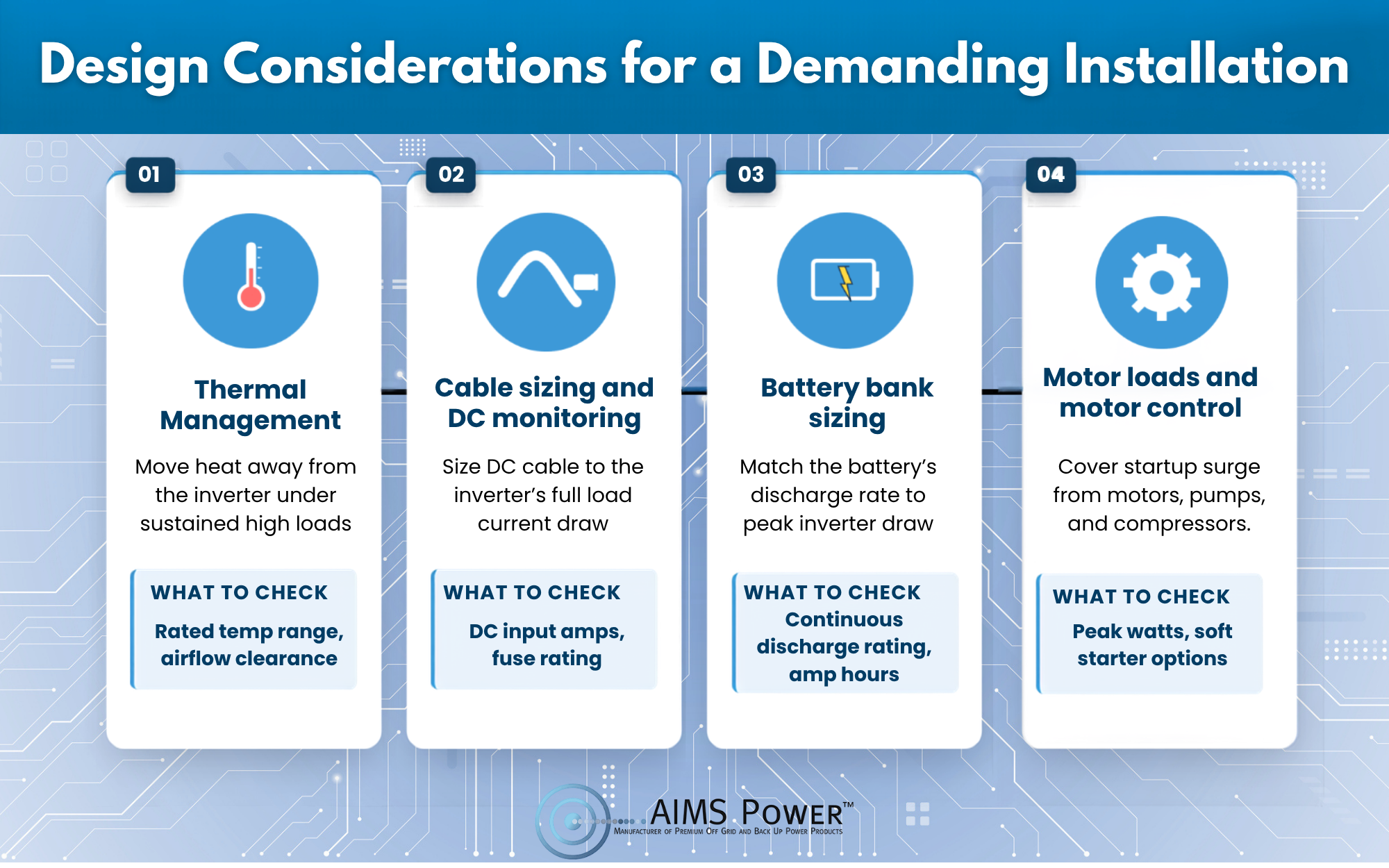
    Design Considerations for a Demanding Installation

    Picking an inverter is half the job. The rest is planning what works with it so the system holds up. 

    Thermal Management 

    High wattage means high heat, especially at maximum power. Give the inverter clearance for airflow, mount it in a space that stays within its rated temperature range, and keep it away from batteries that vent heat of their own. Silicon carbide power stages, used in some higher-end inverter designs, run cooler and hold high efficiency across a wider load band, which helps in enclosed installations.

    Cable Sizing and DC Wiring 

    DC cable size is set by the current the inverter can pull at full load, not by the AC side. A 6,000W 48V inverter can pull 150A or more on the DC side, and a short, correctly sized cable with a properly rated fuse keeps voltage drop and heat under control. AIMS publishes DC input current per model to make this straightforward.

    Battery Bank Sizing

    The battery bank has to support the inverter’s maximum power draw. Lithium (LiFePO4) handles high discharge rates well and pairs cleanly with a high-power inverter charger. The bank capacity in amp hours sets runtime, and the discharge rating sets whether the bank can feed the inverter at peak without sagging.

    Motor Loads and Motor Control 

    Motor loads dominate the surge calculation. Air conditioners, pumps, and compressors all need the peak power rating to cover startup. Soft starters can reduce inrush and let a smaller inverter carry a larger AC unit, which matters in RV and marine builds where space is tight.

    Build Your High-Power System With AIMS Power

    AIMS Power is a U.S. based manufacturer with more than 30 years of experience building power conversion equipment, backed by in-house technical support. AIMS builds pure sine wave inverters and inverter chargers from 3,000W up through 12kW and beyond, along with the lithium battery banks, solar charge controllers, and cable kits that complete a full high power system. For fleets, OEMs, and solar installers, that means one supplier for the inverter, the battery power source, and the accessories that tie them together.

    If you are specing a high power inverter for a demanding installation, contact AIMS Power to size the right unit or to talk through OEM and volume options. To see the full lineup, browse the AIMS Power inverter collection and start matching output, voltage, and waveform to the load.

    Frequently Asked Questions

    What counts as a “high power” inverter?

    There is no single cutoff, but the industry generally uses the term for pure sine wave inverters rated above 3,000 watts continuous. Above that point, 24V or 48V battery systems become standard, cabling gets heavier, and thermal management inside the unit is designed for sustained high output.

    Do I need pure sine wave at high wattage, or will modified sine work?

    For anything with a motor, a variable speed drive, sensitive electronics, or medical equipment, use pure sine wave. Modified sine can run purely resistive loads like heaters and incandescent lighting, but at high wattage most sites carry mixed loads, and the losses and heat on the modified sine side add up quickly.

    How do I know if my battery bank can support a high power inverter?

    Check two things. Capacity in amp hours sets how long the bank runs the load, and the continuous discharge rating sets whether the bank can supply the inverter at its rated output. A high-wattage pure sine inverter can pull hundreds of amps on the DC side, and the battery has to deliver that without voltage sag.

    Why do most high-wattage builds run on 48V instead of 12V?

    At the same power output, 48V draws one-fourth the DC current of 12V. That means smaller cable, smaller fuses, less voltage drop, and higher power density in the finished install. For a 5kW or 10kW inverter, 12V is impractical, and 48V has become the standard for a reason.

    Can a high power inverter work as an uninterruptible power supply?

    Yes. A pure sine wave inverter charger with a fast transfer switch works as a UPS for critical circuits. It holds the load while grid power is present, kicks over to inverter output within milliseconds of an outage, and returns to charging when the grid comes back.


  • DC-DC Charging Off the Alternator in Commercial Vehicles

    DC-DC Charging Off the Alternator in Commercial Vehicles

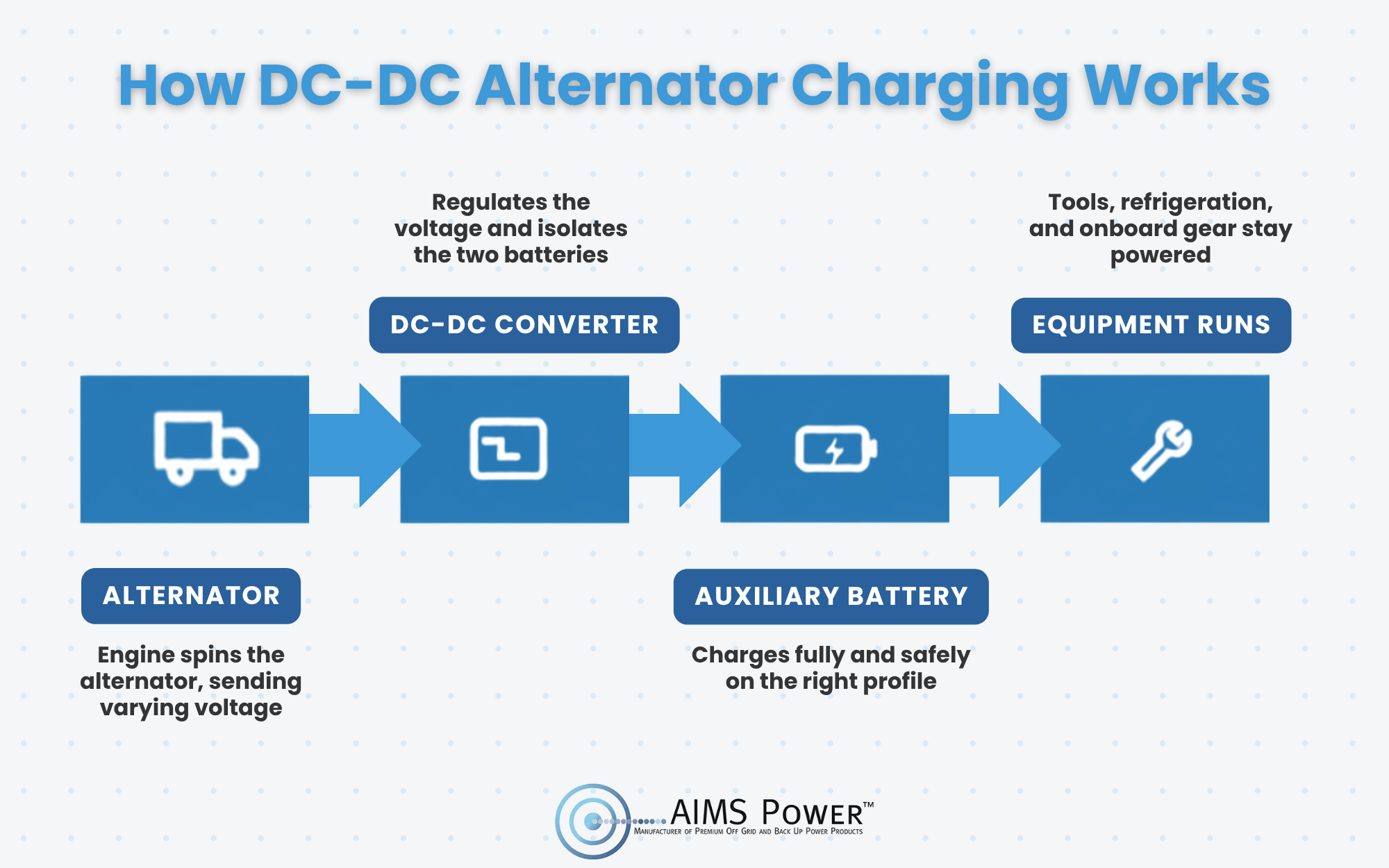
    The Short Answer: A DC-DC converter charges a second battery from the vehicle’s alternator while the engine runs. It takes the varying input voltage coming off the alternator and starting battery, then regulates it to a stable output voltage matched to the exact charge profile the auxiliary battery needs. This lets a work truck, van, or fleet vehicle keep tools, refrigeration, and equipment powered without idling, wiring the batteries directly together, or risking the starting battery.

    Commercial vehicles often carry a second battery for equipment that has nothing to do with starting the engine. It helps power accessories like liftgates, refrigeration, inverters, telematics, and onboard tools. The question is how to charge that auxiliary battery reliably while the vehicle is working. 

    Wiring it straight to the alternator seems simple, but it underperforms and can damage modern batteries. A DC-DC converter solves this by managing the charge properly and understanding how it meets the specific requirements of the build and holds up in the field.

    Where the Alternator Alone Falls Short

    An alternator is built to do one job well: replace the charge the starting battery loses when the engine cranks, then hold the vehicle’s electrical system at a steady voltage. It was never designed to fully charge a deeply discharged second battery or to serve as a controlled power supply for a separate energy storage system.

    Connecting an auxiliary battery directly to the alternator, or tying it to the starting battery through a simple relay, runs into a few problems. The alternator’s output voltage often sits too low to fully charge a deep cycle or lithium battery, so the battery voltage never climbs enough for a complete charge. Voltage drop across long cable runs to a bed-mounted or trailer battery makes this worse. Also, modern lithium (LiFePO4) batteries expect a specific charge profile that a raw alternator feed does not provide, which would shorten their life or trip their internal protection.

    There is also a risk in the other direction. A discharged auxiliary battery wired directly to the system can pull stored energy from the starting battery, leaving the vehicle unable to start.

    How a DC-DC Converter Solves It

    A DC-DC converter sits between the starting battery and the auxiliary battery and controls the energy transfer between them. Instead of passing the alternator’s raw output straight through, this power converter takes the input voltage from the vehicle side and produces a regulated output voltage matched to what the auxiliary battery needs for a full, safe charge. Unlike a linear regulator, which sheds extra voltage as heat, a switching converter moves energy with high efficiency and wastes very little of the alternator’s output.

    Most vehicle units are step-down, or buck converter, designs that bring a higher voltage down to a low voltage, such as a 24V system feeding a 12V battery. A step-up, or boost, converter does the reverse. Matching the direction to your battery voltage is the first spec decision.

    Voltage Regulation and Charge Profile 

    The core function is voltage regulation. The converter accepts a range of input voltages from the alternator and starting battery, which fluctuate with engine speed and load, and delivers a stable DC voltage to the auxiliary battery. 

    Many DC-DC chargers step through a multi-stage charge profile (bulk, absorption, float) so the battery reaches full charge the way its chemistry requires. A direct alternator connection cannot do this on its own.

    Lithium batteries need particular attention when the charging source is an alternator. Alternator output is not built around a lithium charge profile, and a long drive cycle can hold the battery above its safe voltage. A battery voltage regulator sits inline and disconnects the battery from the 12V source when voltage moves outside the safe window, which lets a lithium bank charge from an alternator without overcharging. AIMS offers it in 100 amp and 200 amp sizes. 

    Battery Isolation

    The converter also protects the starting battery by isolating it from the auxiliary side. Because energy only moves in one direction, from the starting side to the auxiliary side, it isolates the two batteries. The auxiliary loads can draw the second battery all the way down without ever touching the starting battery, so the vehicle always starts. This isolation is one of the main reasons fleets move to a DC-DC setup.

    Handling Alternator Conditions

    Vehicle electrical systems are harsh environments for electronics. A converter built for this use can tolerate the voltage swings and wide temperature range of an engine bay. Quality units also include protection against a load dump, the voltage spike that occurs when the alternator is running, and a battery connection that is suddenly lost.

    Matching the Converter to the System

    Specifying the right DC-DC converter for alternator charging comes down to a handful of decisions. The right unit is what separates a system that charges fully on every route from one that underdelivers.


    Spec

    What to consider

    Input voltage

    Match the vehicle system: 12V or 24V. Some converters accept a wide input range for mixed fleets.

    Output voltage

    Set to the auxiliary battery’s chemistry (lead-acid, AGM, or lithium) and its charge profile.

    Output current

    Higher output current charges the battery faster, but the alternator has to supply it.

    Power rating

    The converter’s output power has to fit both the battery bank size and the alternator’s headroom.

    Mounting

    Chassis mount handles vibration and heat in an engine bay or truck body.

    Isolation

    Galvanic isolation adds a layer of separation for sensitive electronics and mixed-voltage systems.

    Output and Current Charge Time 

    Output current sets how fast the auxiliary battery recharges. A higher output current means a shorter charge time, which matters for a delivery vehicle making short trips with the engine cycling on and off. 

    The limit is the alternator: the converter draws its charging current from the vehicle, so the alternator needs enough spare capacity above the vehicle’s own energy consumption to supply it. Higher power converters push more current across a range of power levels, but they demand more from the alternator.

    Lead Acid, AGM, or Lithium

    The auxiliary battery chemistry drives the output voltage setting. Lead acid and AGM batteries charge in one voltage range, while lithium needs a different range along with a specific charge profile. A converter that supports the target chemistry, ideally with a selectable output for lithium, keeps the battery healthy over its full service life.

    Where This Shows Up in the Field

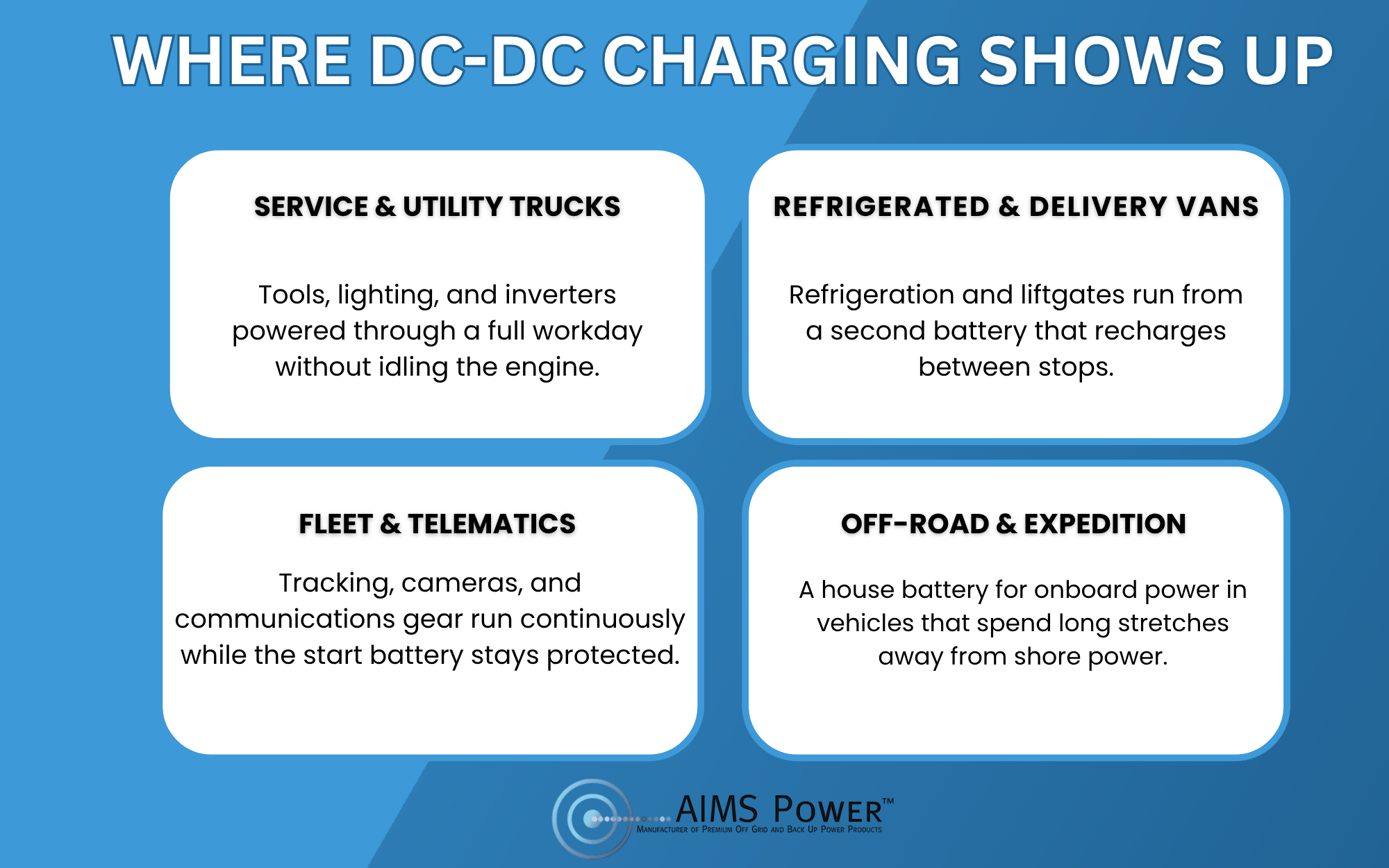
    DC-DC alternator charging is standard practice across a range of commercial builds and various applications:

    • Service and utility trucks: Keeping tools, lighting, and inverters powered from an auxiliary battery through a full workday without idling the engine.
    • Refrigerated vans and delivery vehicles: Running refrigeration or liftgates from a second battery that recharges on the move between stops.
    • Fleet and telematics: Powering tracking, cameras, and communications gear continuously while protecting the starting battery.
    • Electric vehicle and industrial applications: EV and industrial platforms use DC-DC converters to move power from a high-voltage pack down to lower-voltage systems across a storage system, the same principle at higher power.
    • Off-road and expedition vehicles: Charging a house battery for onboard power in vehicles that spend long stretches away from shore power.

    In each case, the DC-DC converter turns the alternator into a reliable charging source for a battery it cannot charge on its own. 

    Build the Charging System With AIMS Power

    AIMS Power is a U.S.-based manufacturer with more than 30 years of building power conversion equipment, backed by in-house technical support. AIMS builds DC-DC step-down converters that handle voltage regulation for auxiliary and accessory circuits, along with the pure sine wave inverters and deep cycle batteries that complete a mobile power system. 

    For fleets, upfitters, and OEMs building this into a vehicle line, this means one complete solution, and the application helps to size the converter to the alternator, the battery voltage, and the load.

    If you are speccing DC-DC charging for a commercial vehicle or a fleet program, contact AIMS Power to match the converter to your system or to talk through OEM and volume options.

    Frequently Asked Questions

    What does a DC-DC converter do in a vehicle?

    It charges an auxiliary battery from the vehicle’s alternator and starting battery while the engine runs. It regulates the varying input voltage into a stable output voltage matched to the second battery’s charge profile, and it isolates the two batteries so the auxiliary loads never drain the starting battery.

    Why not just connect the second battery to the alternator directly?

    A direct connection usually undercharges the auxiliary battery because the alternator’s voltage sits too low for a full charge, and voltage drop across long cables makes it worse. It also offers no isolation, so a drained second battery can pull from the starting battery. Modern lithium batteries in particular need a charge profile a raw alternator feed cannot provide.

    Do I need a DC-DC converter for a lithium (LiFePO4) auxiliary battery?

    In most cases, yes. Lithium batteries expect a specific charge profile and voltage that a standard alternator connection does not deliver. A DC-DC converter set for lithium provides the correct output voltage and staged charging, which protects the battery and lets it reach full capacity with high efficiency.

    How big a DC-DC converter do I need?

    Match the output current to how fast you need the auxiliary battery to recharge, then confirm the alternator has enough spare capacity above the vehicle’s own loads to supply that current. Larger battery banks and faster charging call for a higher power rating, but the alternator sets the ceiling. AIMS technical support can help match the converter to your battery and alternator with live U.S.-based staff as well as bilingual technicians on hand. 

    Can one DC-DC converter charge from the alternator and protect the starting battery at the same time?

    Yes. Because the converter moves energy in one direction only, it charges the auxiliary battery while isolating the starting battery. The second battery can be drawn down by loads without affecting the vehicle’s ability to start.

  • Inverter vs. Converter: What Each One Actually Does in Your Power System

    Inverter vs. Converter: What Each One Actually Does in Your Power System

    The Short Answer: An inverter changes the form of power, turning DC electricity from a battery or solar panel into the AC electricity that standard equipment runs on. A converter changes the level or condition of power instead, either stepping DC voltage up or down or turning AC into DC to charge a battery.

    On a spec sheet or a purchase order, “inverter” and “converter” are often treated as if they mean the same thing, but they do not. One changes the form of power, flipping direct current into alternating current, while the other changes the level or condition of power while keeping it in the same form. Confuse the two when you’re specifying a build and the cost appears later, as a failed component, a warranty claim, or a system that won’t run the load it was sized for. 

    Knowing what a converter does, what an inverter does, and where each one lives in a system, across solar, RV, fleet, and industrial builds, is what keeps the two straight on a spec and shows how they work together in integrated units.

    What a Converter Actually Does 

    A converter changes the voltage level or the condition of power without performing the DC-to-AC flip that defines an inverter. Converters fall into two main types: DC-DC and AC-DC.

    DC-DC Converters

    DC-DC converters move power between voltage levels, keeping it as DC the whole way. A step-down converter safely drops the voltage (discharges) to a lower voltage bank, preventing damage. In a 48V battery system that also has to run 12V accessories, a step-down DC converter takes the 48V down to the 12V those accessories expect. That regulated output is what lets one battery bank safely run components rated for different voltages.

    AC-DC Converters

    AC-DC converters take AC power and produce DC power. A battery charger is the common example: it pulls AC electricity from shore power or the electrical grid and outputs the DC electricity that handles battery charging. In mobile and off-grid builds, this is the unit that keeps the battery bank charged whenever grid or shore power is available. 

    A converter keeps sensitive electronics fed with stable voltage at the level each circuit needs. It’s what makes mixed-voltage electrical systems work in RVs, fleet vehicles, and industrial settings, where a single power source often has to serve components rated for different voltages. 

    What an Inverter Actually Does 

    An inverter converts DC electricity into AC electricity. It takes the direct current stored in a battery or produced by a solar panel or fuel cells and turns it into the AC power that household appliances and commercial equipment expect from a wall outlet.

    Output Quality: Pure Sine vs. Modified Sine

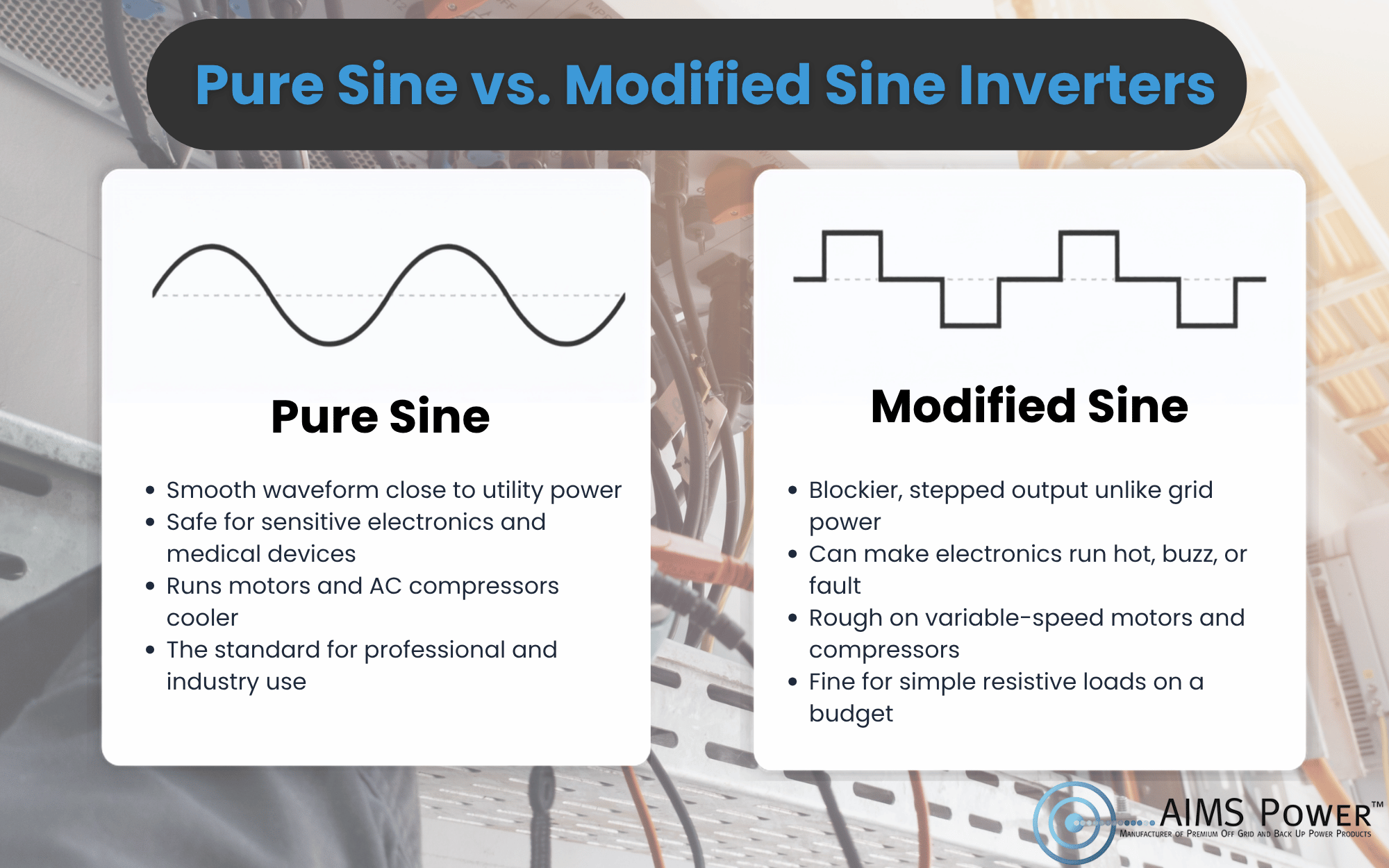
    infographic showing the difference between pure sine and modified sine waves

    Output quality is the biggest difference between inverter types. A pure sine wave inverter produces a smooth waveform close to grid power, with total harmonic distortion typically under 3%. A modified or square wave inverter produces a stepped, blockier waveform. That difference matters for sensitive electronics, variable-speed motors, and air conditioner compressors, which can run hot, buzz, or fault on a square wave. Pure sine wave is the practical standard for professional and industrial applications for that reason.

    Inverter Types by Application

    Different inverter types map to different jobs. A hybrid inverter manages solar, battery, and grid inputs in one unit, which is what most renewable energy systems need. A power inverter sits between a DC power source and AC loads in mobile and off-grid builds. In each case, the output waveform, along with the continuous and surge ratings, determines whether the inverter actually runs the intended load, so those are the specs to check first.

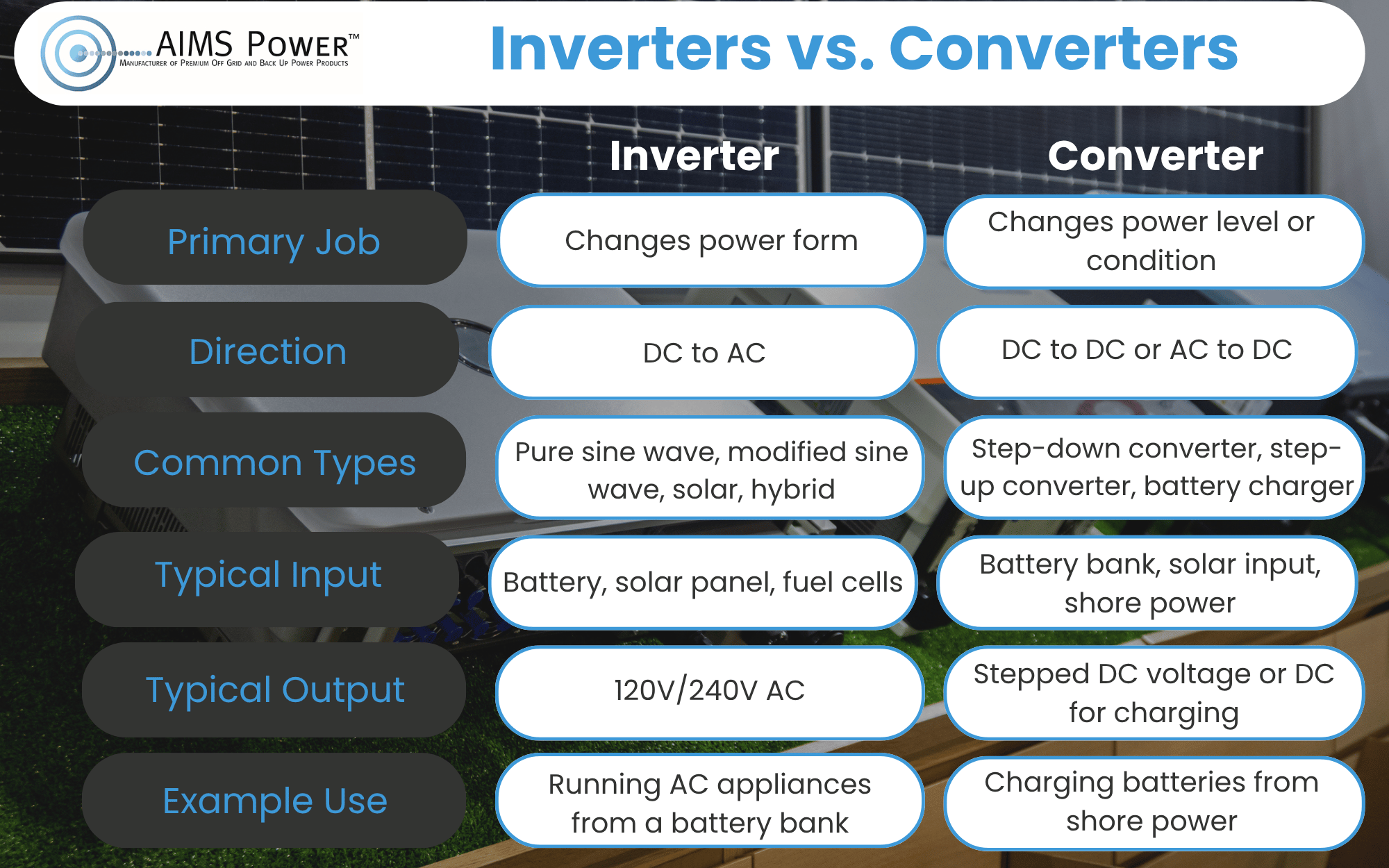
    Inverter vs. Converter: The Core Difference Side by Side

    The cleanest way to separate the two is by the problem each solves. An inverter changes the form of power from DC to AC. A converter changes the level or condition of power, either stepping DC voltage up or down, or turning AC into DC.


    Inverter

    Converter

    Primary job

    Changes power form

    Changes power level or condition

    Direction

    DC to AC

    DC to DC (step up/down) or AC to DC

    Common types

    Pure sine wave, modified sine wave, solar, hybrid

    Step-down converter, step-up converter, battery charger

    Typical input

    Battery, solar panel, fuel cells

    Battery bank, solar input, shore power

    Typical output

    120V/240V AC

    Stepped DC voltage or DC for charging

    Example use

    Running AC appliances from a battery bank

    Charging batteries from shore power

    Where Each Device Shows Up in Real Systems 

    Each device ties to the power requirements of the application, not to a generic slot in a diagram. Here’s where they land across common industries.

    Solar and Renewable

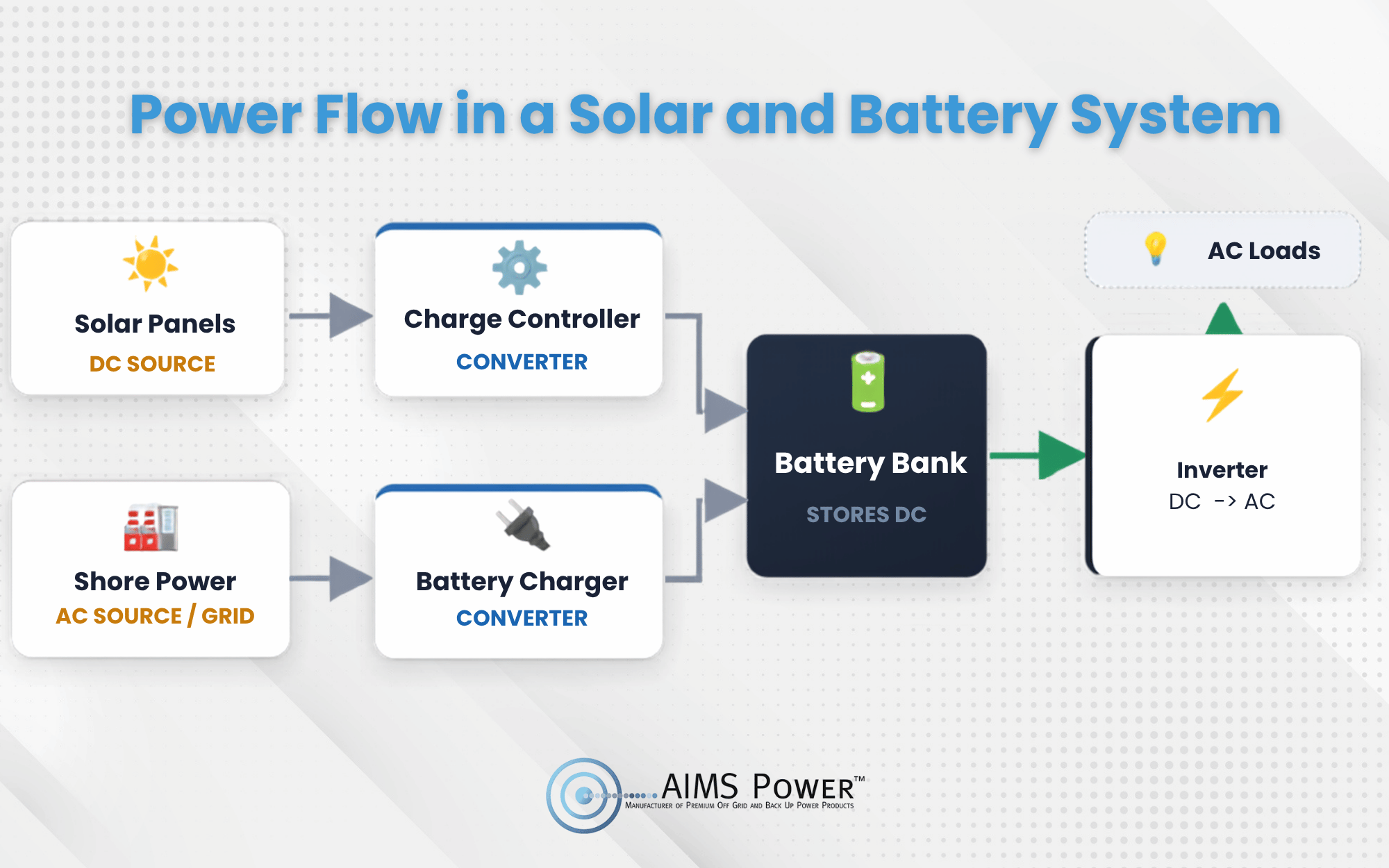
    Solar panels feed a charge controller, which conditions the panel output before it reaches the battery. The battery stores that energy as DC, and an inverter converts it into AC for the loads. In systems that also tie to the grid or run battery backup, a single hybrid inverter can handle the solar, battery, and grid management together.

    RV and Mobile

    These builds usually carry both devices. A converter handles shore power charging, turning 120V AC into the 12V DC that keeps the batteries topped off. An inverter runs the reverse path, powering onboard AC appliances from the battery bank when shore power isn’t available. That combination is why RV and van builds often spec an inverter/charger to cover both jobs in one unit.

    Commercial Vehicles and Fleet

    DC-DC converters feed auxiliary electrical systems rated at different voltages than the main battery, so a 24V truck can still run 12V equipment. Inverters power tools, laptops, and gear from the vehicle’s DC system during field work. For work truck and fleet applications, matching the inverter’s continuous and surge rating to the actual tool load is what keeps the system from tripping under startup draw.

    Electric Vehicle and Industrial

    EV power electronics rely on inverters to drive AC motors and on DC-DC converters to supply lower-voltage systems from the main pack. Industrial settings use the same split to match each load to its voltage and current requirements. The scale is larger, but the roles don’t change: inverters handle the form of the power, converters handle its level.

    Matching each device to the application, rather than treating them as generic parts, is what keeps a build from being under-specified or over-specified.

    How Inverters and Converters Work Together

    Inverters and converters rarely work alone. In most builds, they run as a system, each handling its part of the power path depending on which source is live. 

    Picture a system with solar panels, a battery bank, and shore power charging. The charge controller (a converter) conditions the solar input, the battery stores DC, the inverter produces AC for the loads, and a charger (also a converter) tops the battery from shore power when it’s available. Each function switches on with its source.

    Some builds fold several of those jobs into a single device. An inverter/charger inverts DC to AC and, on the reverse path, charges the battery from shore power or the grid. A hybrid inverter adds solar and grid management to that same box. Where space, cost, and part count matter, one integrated unit can stand in for two or three separate ones.

    For purchasing and engineering teams, the spec checklist stays consistent:

    • System voltage (12V, 24V, or 48V)
    • Continuous and surge load
    • Required output waveform (pure sine or modified sine)
    • Thermal and environmental conditions of the installation
    • Serviceability and supplier support at volume

    Choosing the Right Device for Your Build

    A converter changes the level of power, stepping DC voltage up or down or turning AC into DC for charging. An inverter changes DC into AC to run standard equipment. Both do distinct work, and most real systems use them together. Getting that call right up front is what keeps a wrong spec from turning into a field failure later.

    AIMS Power manufactures both sides of that equation: pure sine wave inverters, DC-DC step-down converters, inverter/chargers, and hybrid inverters, backed by U.S.-based technical support. For OEMs, installers, dealers, and fleet teams spec’ing power into a product or operation, that means one source for the components and the application help to match them to the load. If you’re sourcing at volume or building a power system into what you sell, contact AIMS Power for spec support or to talk through an OEM or reseller partnership.

  • Standardizing Power Across a Mixed Commercial Fleet

    Standardizing Power Across a Mixed Commercial Fleet

    The Short Answer: Standardizing power across a mixed commercial fleet means picking a small set of pure sine wave inverters, battery voltages, and mounting formats that cover most of the fleet, then speccing those same units on every new build and every replacement. A fleet vehicle power inverter platform built this way cuts parts inventory, simplifies tech training, and makes sure every driver has the same reliable power for tools, laptops, telematics, and onboard equipment.

    Fleets grow one vehicle at a time. A service truck gets a 1500W inverter one year, a delivery van gets a different brand at a different voltage the next, and the box truck added last quarter runs a 3000W setup nobody has serviced yet. After a few years, the fleet ends up with five inverters from three manufacturers on four mounting formats, and the shop keeps parts for all of them. 

    Standardizing power fixes that by treating inverters as a fleet-wide platform, not a per-vehicle decision. We break down why mixed fleets drift into mixed systems, what a standardized spec looks like, and how to handle real differences between vehicle types without breaking the standard.

    Why Mixed Fleets End Up With Mixed Power Systems 

    Most fleets do not set out to run five different inverter setups. They inherit them. Vehicles come from different OEMs, get upfitted at different shops, and enter service years apart. Each build reflects what was available, what the upfitter usually installed, or what the driver requested at the time. None of it is wrong on its own, but it’s not coordinated across the fleet.

    The result is a working system inside each vehicle and a fragmented system for the fleet manager. Different battery chargers charge to different voltages. Different inverter brands respond differently to load dumps on the vehicle electrical system. A tech trained on one platform has to figure out another on the side of the road. When one fails, the shop needs the right replacement parts for that specific unit, and the vehicle sits useless until they arrive.

    The Cost of Not Standardizing 

    The visible costs are downtime and cost of parts. The hidden costs are worse and add up faster. 

    • Parts inventory grows with every added SKU. Five different inverters mean five sets of fuses and remote panels. 
    • Diagnosis time climbs when techs have to identify which unit they are looking at before they can start troubleshooting.
    • Warranty handling splits across multiple manufacturers, each with their own RMA process and support hours.
    • Driver experience varies vehicle to vehicle, so the same job feels different and takes longer in the wrong truck.
    • New upfits cost more because every build starts from scratch instead of applying a proven spec sheet.

    None of these show up as a line item. They show up as slower repairs, more truck rolls, and quiet inefficiency across the fleet. 

    What Standardized Fleet Power Spec Actually Looks Like 

    Standardization does not mean one inverter for every vehicle. It means a defined platform with a few clear rules that every new build follows. A fleet-wide spec typically covers five things.

    Pure Sine Wave Output 

    Every vehicle in a fleet carries some form of sensitive electronics: laptops, tablets, telematics units, mobile printers, scanners, or medical equipment on an emergency vehicle. All of them expect consistent, low-DHR AC power. A pure sine wave inverter is the base of a fleet standard for exactly this reason. It removes a whole category of field failure possibilities at the source.

    Battery Voltage 

    Most passenger cars, light trucks, and vans run 12V vehicle electrical systems, so 12V is the default fleet standard. Larger commercial vehicles and some utility vehicles run 24V or 48V. If the fleet mixes both, a wide-input inverter or a DC-DC converter step can bridge them without requiring a second inverter platform.

    Wattage Tiers

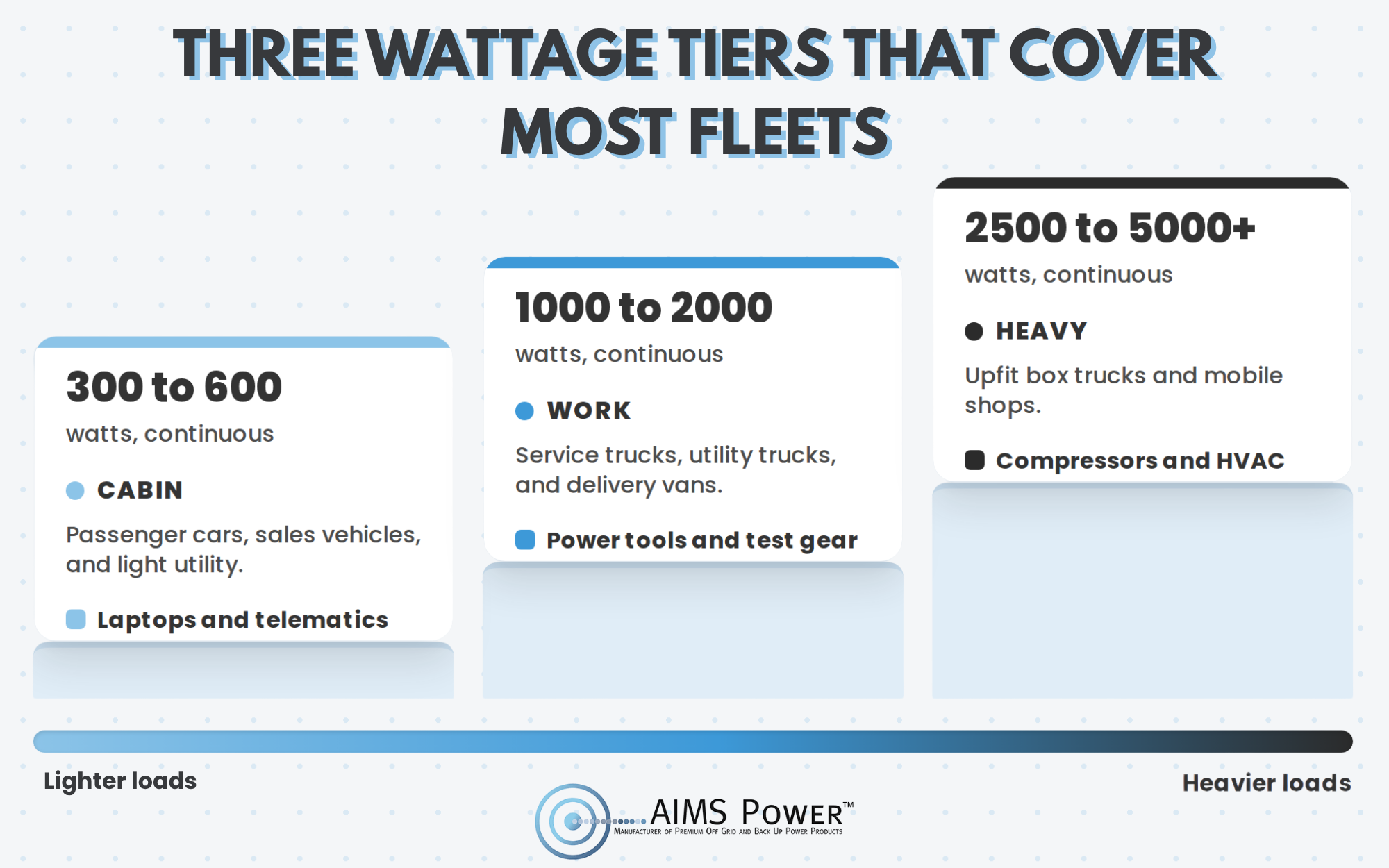
    One inverter size does not cover everything. Instead, most fleets pick two or three tiers that cover 80% or more of their vehicles. A small tier for cabin electronics, a mid tier for tools, and a large tier for full mobile shops or refrigeration.

    Certification and Duty Cycle 

    AIMS Power’s ETL listed inverters are certified to UL 458 or UL 1741, so the paperwork is already done when a fleet spec calls for it. Pair that with a duty cycle rating that matches how the vehicle actually runs, whether the inverter cycles briefly at each stop or holds continuous load for a full shift.

    Picking Wattage Tiers That Cover the Fleet 

    Most mixed fleets fit inside three inverter tiers. The table below shows how they usually break down by vehicle type and load: 

    Tier

    Typical continuous power

    Vehicle types

    Loads its powers

    Cabin

    300 to 600W

    Passenger cars, sales vehicles, light utility

    Laptops, tablets, chargers, telematics, small printers

    Work

    1000 to 2000W

    Service trucks, utility trucks, delivery vans

    Power tools, test equipment, small compressors, task lighting

    Heavy

    2500 to 5000W and up

    Utility trucks, upfit box trucks, mobile shops

    Air compressors, welders, refrigeration, rooftop HVAC


    A fleet that picks one unit per tier and specs it across every new build brings the total inverter SKU count from five or six down to three, without giving up capability on any vehicle. 

    Handling Vehicle Differences Without Breaking the Standard

    Vehicles inside a fleet still differ in ways that matter to a power system: alternator capacity, vehicle battery type, cab space, and whether the vehicle has an auxiliary battery at all. A fleet standard has to bend around those differences without letting them proliferate into new inverter SKUs.

    The usual pattern is to keep the inverter tier fixed and let the supporting components vary. A vehicle power inverter in the same wattage tier can sit on top of multiple different battery banks, DC-DC chargers, and mounting locations without changing the inverter itself. That keeps the tech-facing platform consistent while letting each vehicle carry the auxiliary hardware it needs.

    Two main components make this practical.

    DC-DC Converter 

    A DC-DC converter on each vehicle regulates charging from the alternator into the auxiliary battery that feeds the inverter. Different alternators can feed the same auxiliary battery voltage through the right converter.

    Inverter Charger 

    An inverter charger on vehicles that connect to shore power (overnight yard charging, for example) combines inversion and battery charging in one unit so the fleet does not carry a separate battery charger SKU.

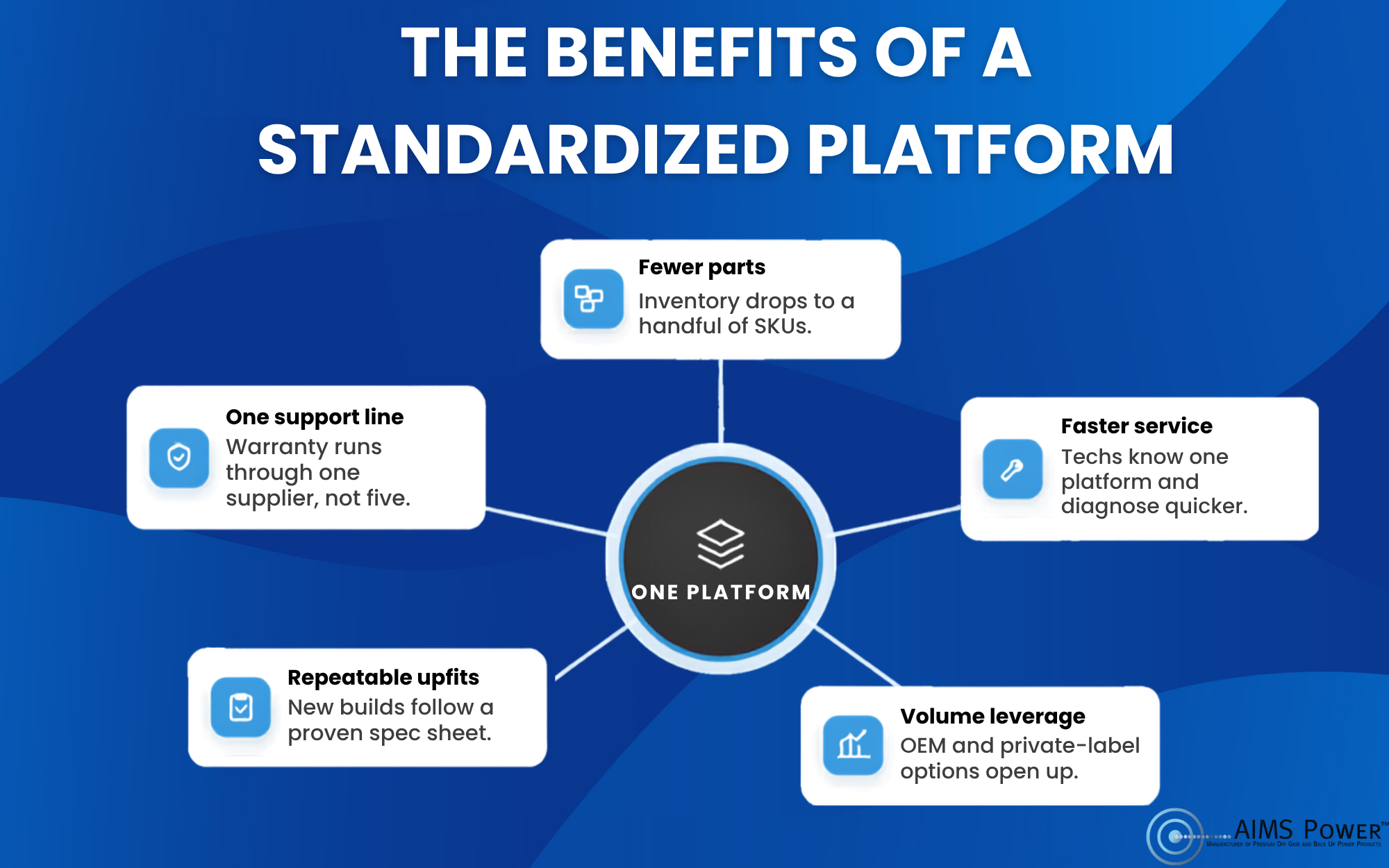
    The Benefits of a Standardized Platform

    The benefits show up in the shop first and in the total cost of ownership over years.

    • Parts inventory drops to a handful of SKUs the shop keeps in stock.
    • Techs only have to learn one platform and diagnose it faster on every truck.
    • New upfits use a proven build sheet instead of starting from a blank page.
    • Warranty and technical support run through one manufacturer relationship, not five.
    • OEM and private-label options open up on volume, since one supplier is covering a bigger share of the fleet.

    For fleet managers working to reduce downtime and per-vehicle upfit cost, standardizing the power platform is one of the cleaner wins available.

    Standardize Your Fleet Power With AIMS Power 

    AIMS Power is a U.S. based manufacturer with more than 30 years building power conversion equipment, backed by in-house technical support. We build pure sine wave inverters, inverter chargers, DC-DC converters, and deep cycle batteries in the wattage tiers that cover cabin, work, and heavy fleet use, all designed to hold up in commercial vehicle environments. For fleets, upfitters, and OEMs specing a consistent build across a mixed fleet, one supplier handling the inverter, charger, and battery side simplifies the platform end-to-end.

    If you are standardizing power across a commercial fleet, contact AIMS Power to spec the platform for your vehicle mix, or ask about OEM and volume options. To see the equipment first, browse the AIMS Power inverter collection and start matching output and voltage to your fleet tiers.

    Frequently Asked Questions

    Why standardize inverters across a fleet with different vehicle types?
    Because the vehicles differ but the operational problems repeat. Standardizing means one set of parts, one training track for techs, one warranty relationship, and one proven spec for new upfits. The vehicles can still vary in size and role. What stays consistent is the power platform inside them.

    Can one inverter model cover every vehicle in a mixed fleet?
    Rarely. Most fleets need two or three wattage tiers to cover cabin, work, and heavy use without underpowering the big trucks or oversizing the small ones. The standard is the tier structure, not a single SKU.

    What voltage should a fleet standardize on?
    For most fleets in the United States, 12V is the default because passenger cars, vans, and light commercial vehicles run 12V electrical systems. Fleets with larger 24V vehicles can add a DC-DC converter to bridge without adding a second inverter platform.

    How do fleets keep the standard when new vehicle types get added?
    By fitting the new vehicle to the existing tier structure rather than picking a fresh inverter. If the new vehicle’s loads land inside a defined tier, use the same inverter. If they push past the top tier, add a fourth tier once, not a new one-off per vehicle.

    Do standardized fleet inverters need pure sine wave output?
    For most fleets, yes. Laptops, tablets, telematics units, and any modern electronics on the vehicle expect grid-quality AC. Pure sine wave is the base spec that keeps sensitive electronics working reliably across every vehicle in the fleet.

  • Inverter Efficiency Curves and No-Load Draw in Always-On Systems

    Inverter Efficiency Curves and No-Load Draw in Always-On Systems

    The Short Answer: A power inverter does not operate at a single flat efficiency rate. As the load changes, the conversion efficiency changes along a specific curve. In an always-on system, the inverter draws a small amount of power even when no loads are connected, known as no-load draw or standby consumption. Accounting for both the efficiency curve and the standby load prevents unexpected battery drain and ensures reliable power across all varying power levels.

    Designing an off-grid electrical setup, a commercial fleet vehicle, or a continuous backup power source requires more than just matching watt ratings. Understanding how a power inverter manages energy consumption under different conditions dictates how well the entire system performs in the real world. 

    A system that ignores the inverter’s efficiency curve and idle power consumption will underperform, leaving batteries depleted when you need them most. This guide explains how to read efficiency data, manage no-load draw, and select the right equipment to maximize total output power.

    What is Power Inverter Efficiency?

    Power inverter efficiency measures how effectively a unit converts DC power from a battery bank or solar system into AC power for your equipment. No power conversion process is perfect. During the transformation, a certain percentage of the input power is lost, primarily as heat.

    If an inverter has an efficiency rating of 90 percent, it means that 90 percent of the DC input becomes usable AC output. The remaining 10 percent is lost to the conversion process. When you calculate the total energy consumption of your setup, you must account for the power the load requires plus the power the inverter consumes to do its job.

    Most reliable inverter manufacturers design their equipment to minimize these losses. However, the exact efficiency rate fluctuates based on how much output power is being drawn at any given moment.

    Reading the Inverter Efficiency Curve

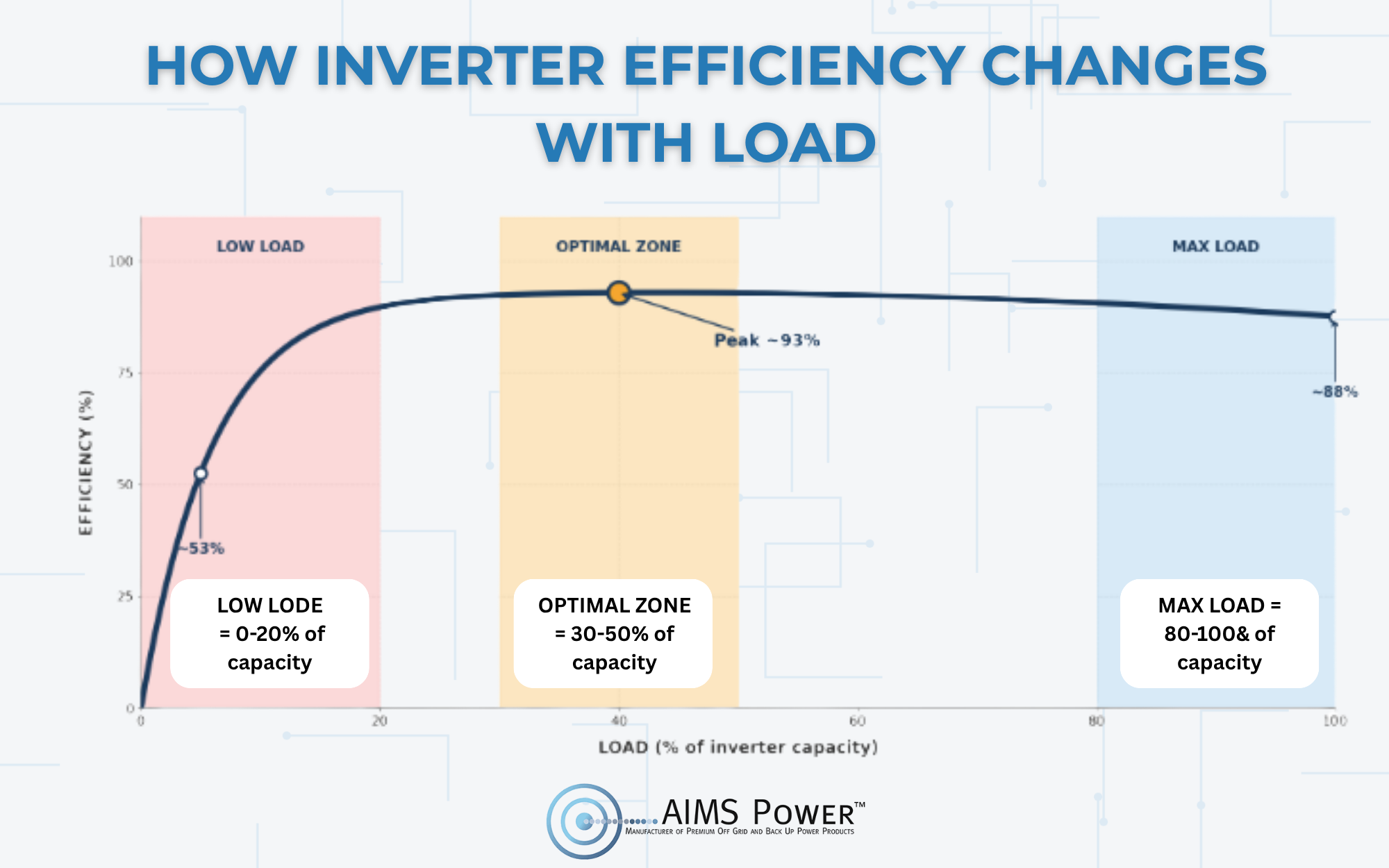
    The power inverter efficiency you see on a specification sheet is often a peak rating. This peak number is a predicted value that occurs under optimal conditions, typically when the load is between 30 and 50 percent of the unit’s total capacity. The efficiency does not remain static across all power levels. Instead, it follows an efficiency curve.

    infograpic showing inverter efficiency for different loads

    Low Load vs. High Load Performance

    When you plot conversion efficiency on a graph, it forms a curve that climbs quickly, plateaus at the peak efficiency range, and then slowly tapers off as the inverter approaches its maximum load limit.

    • Low Loads: Running a 40-watt laptop computer on a 3000-watt inverter will yield lower efficiency. The base power required to operate the inverter’s internal components represents a large percentage of the total input power.
    • Optimal Loads: Operating loads at 30 to 50 percent of the unit’s capacity usually hits the peak of the curve.
    • Maximum Loads: Pushing the inverter near its maximum watt rating generates more heat, which slightly lowers the efficiency.

    Engineers mapping out energy consumption for large commercial projects often use a statistical model to track this curve. By measuring the power factor and load demand at each specific time throughout the day, they can accurately calculate the total daily power consumption and ensure the battery bank is sized correctly.

    The Hidden Drain: Standby Consumption and No-Load Draw

    In an always-on setup, the power inverter remains powered up even when no equipment is actively drawing AC power. During this idle time, the unit still consumes energy. This is known as no-load draw, standby load, or standby consumption.

    Even without an active load, the internal power electronics require a continuous flow of DC input to remain operational. The inverter must maintain its internal sensors, power its cooling fans, keep the sine wave generator active, and supply voltage to any built-in displays or active USB ports.

    This standby consumption adds up over a 24-hour period. If a large inverter has a no-load draw of 2 amps at 12 volts, it consumes 24 watts continuously. Over 24 hours, that standby load pulls 576 watt-hours from the battery bank, completely independent of the actual equipment you plug in.

    Managing No-Load Draw

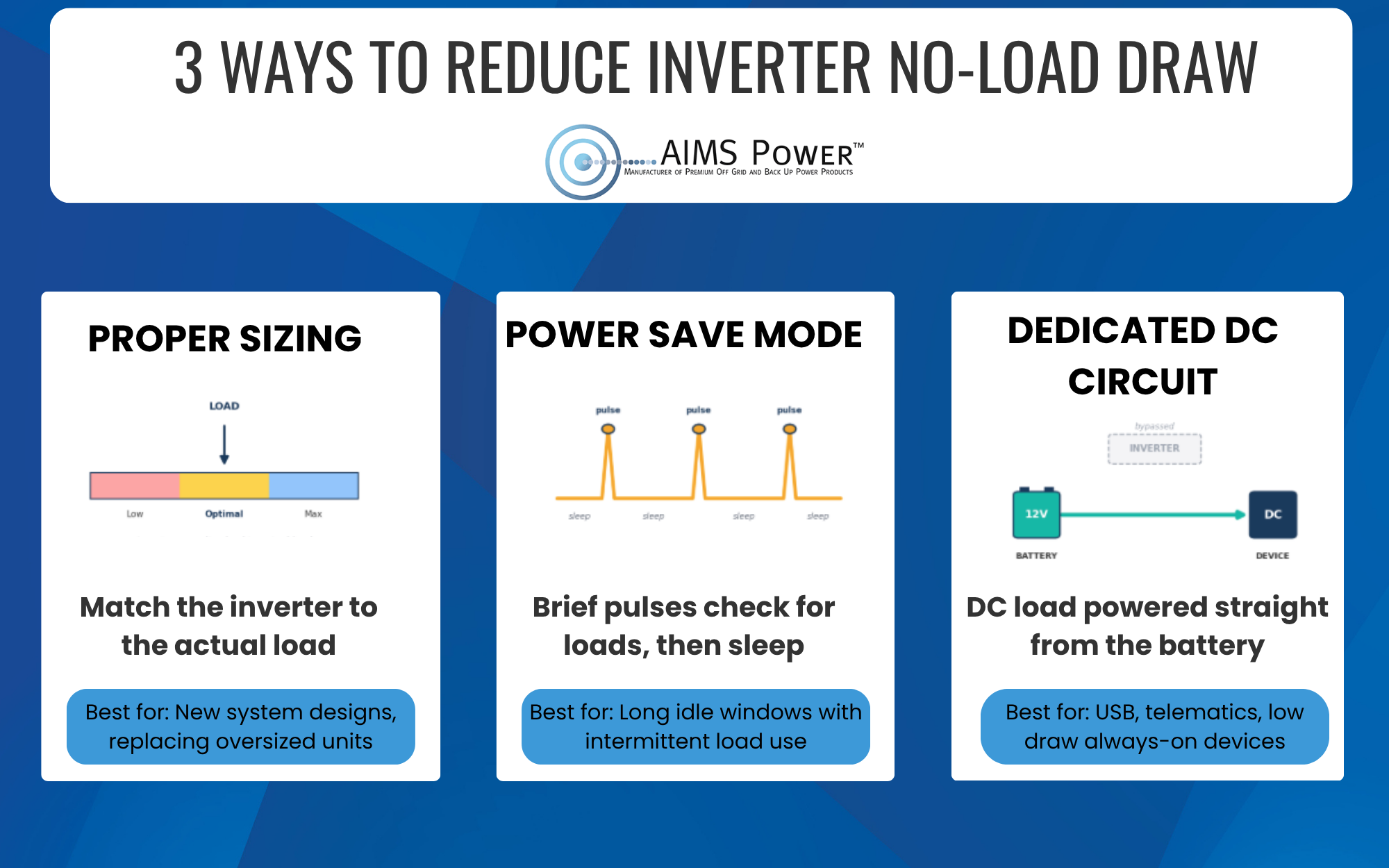
    infographic showing the 3 top ways to reduce inverter no load draw

    To prevent excessive battery drain, system designers implement several strategies:

    • Proper Inverter Sizing: Avoid installing a massive inverter for very small, continuous loads. Sizing the unit close to the actual power demand keeps the no-load draw proportional to the battery bank.
    • Power Save Modes: Many modern power devices feature a sleep or power save mode. The inverter drops its output voltage and pulses the line to detect a load, drastically reducing the stand-by load until a device is turned on (resistive loads only)
    • Dedicated DC Circuits: For small electronic device charging, running a dedicated DC circuit directly from the battery bypasses the inverter entirely.

    Advanced Components and Conversion Efficiency 

    The internal architecture of the inverter dictates both its efficiency curve and its resting power consumption. Modern high-frequency inverters operate differently than older designs.

    Comparing a modern PSW inverter (pure sine wave inverter) to older technology highlights these advancements. A traditional transformer-rectifier design relies on heavy copper coils and iron cores. While physically heavy and capable of handling massive surges, these units often have higher no-load draws.

    Modern power module design utilizes advanced solid-state semiconductors and high-speed switching components. By minimizing internal electrical resistance and heat loss, these power electronics convert energy cleanly and stay cooler under load. This directly translates to higher conversion efficiency, stable power delivery, and significantly reduced standby consumption across extended runtimes.

    System Design and Solar Integration

    The inverter’s efficiency directly impacts how you size your solar power array and battery storage. If you rely on solar energy to recharge your system, your solar panels must generate enough power to replace both the energy used by your tools and the energy lost during power conversion.

    Factoring in Solar Production

    A dedicated solar inverter managing high-voltage PV input operates under similar efficiency rules. Whether you use a combined inverter charger or separate components, the total solar production must exceed total energy consumption.

    System Component

    Sizing Consideration

    Battery Bank

    Must hold enough capacity for the load plus the inverter’s conversion losses and continuous standby consumption.

    Solar Panel Array

    Must produce enough daily wattage to clear the inverter’s no-load draw before actively charging the battery bank.

    Inverter Sizing

    Should be sized so that standard daily loads fall into the 30 to 50 percent capacity range to maximize the inverter’s efficiency curve.

    When designing a solar system for mobile fleets or stationary grid service applications, every watt matters. A highly efficient inverter reduces the number of solar panels required to maintain the battery bank, saving space and weight on commercial vehicles.

    You can explore various configurations and equipment requirements by reviewing professional-grade power inverters to match your exact load profile.

    Selecting the Right Equipment for Always-On Applications

    Matching the Inverter Size to the Load

    Matching the equipment to the application ensures you do not waste battery capacity. A telematics system on a commercial truck drawing 20 watts continuously does not need a 4000-watt inverter running 24/7.

    Instead, operators often split their power source needs. They might use a small, highly efficient inverter for continuous low-draw networking equipment while reserving a larger unit exclusively for heavy tools that only run a few hours a day.

    Integrated Power Management

    If your application requires integrating shore power, alternator charging, and battery inversion into one system, selecting equipment that manages these transitions efficiently is critical. Units designed with a low standby load and a highly optimized sine wave output keep your sensitive equipment safe without unnecessarily draining your reserves.

    For complete power management, integrating reliable inverter chargers simplifies the wiring while providing precise control over battery charging profiles and idle power consumption.

    Build Your Power System With AIMS Power 

    AIMS Power is a U.S.-based manufacturer with more than 30 years of experience building power conversion equipment and renewable energy solutions. We provide technical expertise and reliable power products for OEMs, commercial fleets, RV manufacturers, and solar installers. Our equipment is designed to deliver clean AC power with highly optimized efficiency curves and manageable standby consumption rates.

    Whether you need a low-frequency inverter for heavy motor loads, a lightweight high-frequency unit for mobile applications, or high-capacity batteries and solar panels to complete an off-grid build, AIMS Power delivers the technical foundation your project requires.

    Contact our technical support team to spec out a custom power system, or browse the complete line of AIMS Power solutions to find the right equipment for your next commercial application.

    Frequently Asked Questions

    What does “no-load draw” mean on an inverter specification sheet?

    No-load draw refers to the amount of DC power the inverter consumes from the battery when it is turned on but not actively powering any AC loads. This covers the energy required to run the internal electronics, displays, and cooling systems.

    Does a larger power inverter consume more power when idle?

    Generally, yes. Larger inverters contain more heavy-duty internal components that require more energy to remain active. This is why sizing your inverter closely to your actual power demand helps preserve battery capacity in always-on systems.

    Why is inverter efficiency highest at 30 to 50 percent load?

    At very low loads, the inverter’s fixed internal power consumption makes up a large percentage of the total energy used, resulting in low efficiency. At very high loads, thermal resistance and heat loss increase. The 30 to 50 percent range balances these factors, representing the “sweet spot” where the internal components operate most effectively.

    How does power save mode improve standby consumption?

    Power save mode allows the inverter to drop its output voltage and enter a sleep state when no loads are detected. It sends out a brief pulse every few seconds to check for a load. If you turn a device on, the inverter immediately wakes up and delivers full ac output. This drastically reduces the continuous battery drain during long periods of inactivity.

    How do I calculate the total daily power consumption of my system?

    To find your exact power consumption, you must add the daily load of your equipment to the energy the power inverter requires to operate. First, calculate the daily watt-hours of your connected devices. Next, divide that number by the inverter’s peak efficiency rating (such as 0.90 for 90 percent efficiency) to account for the energy lost during conversion. Finally, calculate the standby consumption by multiplying the unit’s no-load draw (in watts) by 24 hours. Adding these figures together shows exactly how much capacity your battery bank must deliver every day to keep the system running.

  • Designing a Commercial Off-Grid Solar Power System

    Designing a Commercial Off-Grid Solar Power System

    The Short Answer: A commercial off-grid solar power system runs entirely on its own, with no connection to the utility grid. It typically combines a solar array, a charge controller, a battery bank, and an inverter, each sized to the site’s load and daily sun hours. Get the sizing and component match right, and the system delivers reliable power around the clock. Get it wrong, and it either falls short under load or costs far more than the application needs.

    Designing an off-grid system for a business is a different job than wiring up a weekend cabin. The loads are larger, the uptime requirements are stricter, and the cost of a system that underperforms is felt fast. This guide walks through the core components, how to size them to real energy needs, how to choose a battery chemistry, and the design decisions that separate a commercial build that holds up from one that doesn’t. 

    The Core Components of an Off-Grid Solar Power System

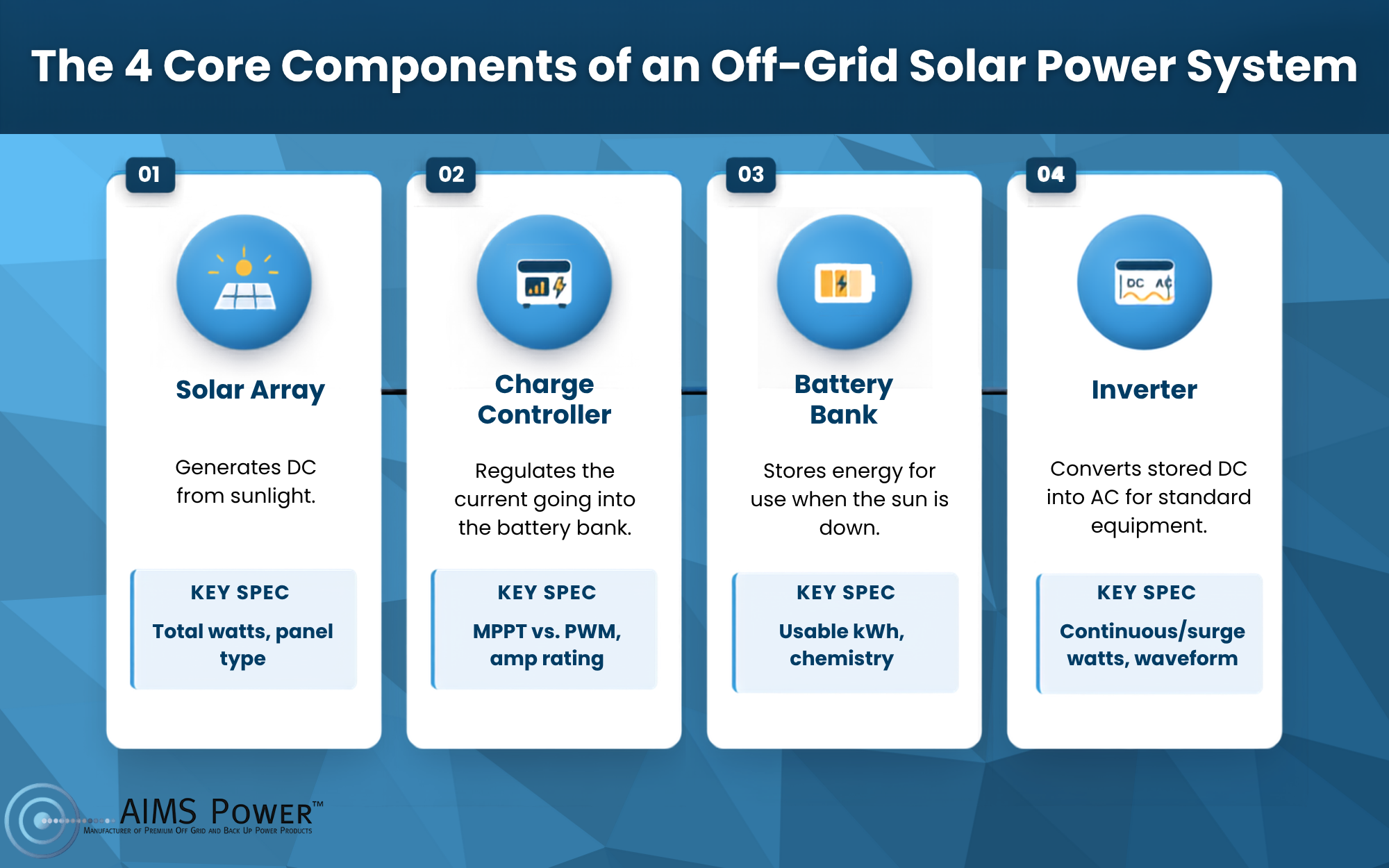
    Every off-grid solar power system runs on the same four parts. Understanding what each one does is the starting point for any design:

    Component

    Job

    Key spec to check

    Solar array

    Generates DC from sunlight

    Total watts, panel type

    Charge controller

    Regulates charging

    MPPT vs. PWM, amp rating

    Battery bank

    Stores energy

    Usable kWh, chemistry

    Inverter

    Converts DC to AC

    Continuous/surge watts, waveform

    Solar Array

    The solar array is the group of solar panels that captures solar energy and turns it into direct current. Array size, measured in watts, sets how much energy the system can generate on a given day. For commercial builds, each solar panel’s quality and the mounting hardware matter as much as raw wattage, since the array has to hold up in the field for decades.

    Charge Controller

    A charge controller sits between the solar array and the battery bank. It regulates the voltage and current coming off the panels so the batteries charge safely and reach maximum power without overcharging. An MPPT solar charge controller pulls more usable energy from the array than an older PWM design, which is why it’s the standard for larger systems.

    Inverter

    The inverter converts the direct current stored in the batteries into the alternating current that standard equipment and household appliances run on. For any commercial load with motors, compressors, or electronics, a pure sine wave inverter is a practical requirement.

    Sizing the System to the Load 

    The design starts with the load, not the panels. Oversize the array, and you pay for capacity you never use. Undersize the battery bank and the system dies overnight. 

    Start With an Energy Audit 

    List every device the system has to run, its wattage, and how many hours a day it runs. Multiply to get watt-hours per day. That daily total is the number the rest of the design is built around. For commercial sites with mixed loads, separate the constant loads like controls and refrigeration from the intermittent ones like tools and pumps.

    Size for Power, Not Just Energy

    Your daily watt-hours size the battery bank and array, but they don’t tell you how much the system has to deliver at once. Add up the running wattage of everything that could run simultaneously to find your peak load, then account for startup surge. Motors, compressors, and pumps can pull two to five times their running wattage the moment they switch on, so the inverter’s surge rating has to cover that spike or it will trip. This peak-plus-surge number sets your inverter size, separate from the energy total that sizes storage.

    Factor in Sun Hours and Days of Autonomy

    Daily energy needs tell you how much the array has to produce. Peak sun hours, a location’s usable solar production per day, tell you how big the array has to be to produce it. Days of autonomy, how long the system runs with no sun, tell you how big the solar battery bank has to be. Remote locations with long overcast stretches need more storage, not just more panels.

    A rough sizing path:

    • Daily load (watt-hours) ÷ peak sun hours = array size needed
    • Daily load × days of autonomy ÷ usable battery depth ÷ system efficiency = battery capacity needed
    • Peak simultaneous load = minimum inverter continuous rating

    AIMS Power’s solar sizing tool can run these numbers for a specific site, which is worth doing before you commit to a parts list.

    Lithium vs. Lead-Acid: Choosing a Battery Chemistry

    Battery choice drives cost, lifespan, and maintenance more than any other single decision in the build. Two chemistries dominate off-grid work.

    Feature

    Lithium (LiFePO4)

    Lead-Acid (AGM)

    Usable depth

    ~80-100%

    ~50%

    Cycle life

    3,500+ cycles

    500-1,200 cycles

    Weight

    Lighter

    Heavier

    Maintenance

    Low maintenance

    Higher

    Upfront cost

    Higher

    Lower

    A lithium battery built on lithium iron phosphate (LiFePO4) chemistry delivers more usable capacity per amp-hour with high efficiency, a longer cycle life, and low maintenance operation. Lead acid batteries cost less upfront but have shorter lifespans and give you only about half their rated capacity before you risk damage. 

    For a commercial system that cycles daily, the longer service life of lithium usually wins on total cost over the life of the system. For budget-driven or backup-only builds that cycle rarely, AGM lead-acid batteries can still be the right call.

    Off-Grid, Grid-Tied, or Hybrid: Picking the Right Configuration

    Not every site that wants solar should go fully off-grid. The configuration you choose shapes the whole component list. 

    Fully Off-Grid

    An off-grid system has no connection to the utility grid at all. It’s the right call for remote areas where extending grid power is expensive or impossible: telecom sites, agricultural operations, remote monitoring stations, and job sites far from a utility line. 

    Everything the site uses has to come from the array and battery bank, which puts a premium on accurate sizing. Many commercial off-grid systems also include backup generation or additional energy sources to maintain uptime during extended periods of low solar production.

    Grid-Tied and Hybrid

    A grid-tied setup runs alongside utility power and can feed excess electricity back to the grid. A hybrid system adds a battery bank on top of that, so the site keeps running as backup power when the grid goes down and can lean on stored solar during peak-rate hours to cut the bill. AIMS Power’s 9.6 kW hybrid inverter and solar panel kit packages that whole approach into one system, combining grid tie, battery backup, net metering, and generator backup. 

    For businesses chasing energy independence, lower electricity costs, and more resilience, hybrid is often the better fit than going fully off-grid. The decision comes down to whether grid power is available, what it costs, and how critical uptime is.

    Design Practices That Hold Up in Commercial Builds

    A few decisions separate a system that runs for years from one that generates service calls.

    • Size for the worst month, not the average. Winter sun hours in many regions are half the summer figure. A year-round system needs to account for the difference.
    • Build in headroom. A system run at 100% of spec every day wears down faster, and the extra room makes future expansion easier.
    • Match the inverter to surge loads. Motors and compressors draw several times their running wattage at startup. A power inverter sized only to average running watts will trip.
    • Plan for serviceability. Commercial sites need parts that can be sourced and replaced quickly, backed by a supplier with real technical support. AIMS Power backs its equipment with strong manufacturer warranties, including multi-year coverage on inverters and all-in-one units and lifetime coverage on its lithium batteries. 
    • Protect the electronics. Fusing, disconnects, and correct cable sizing keep the system safe and code-compliant.

    Any commercial solar installation should be signed off by an electrical engineer or an experienced installer before it’s built.

    Where Commercial Off-Grid Solar Often Gets Used

    Off-grid solar power shows up anywhere reliable power is needed without a utility connection:

    • Telecom and remote monitoring in remote locations
    • Agricultural pumping and controls
    • Construction and job-site power
    • Home backup and backup systems for critical facilities
    • Off-grid living builds, cabins, and tiny homes for builders serving that market
    • Portable power station and solar generator setups for mobile operations

    The same core design applies across all of them. What changes is the size and scale of each part.

    Designing Your Off-Grid System With AIMS Power

    AIMS Power designs, builds, and tests the core parts of an off-grid solar power system in-house: pure sine wave inverters, MPPT solar charge controllers, LiFePO4 lithium batteries, solar panels, and complete solar kits, backed by more than 25 years of experience and U.S.-based technical support. For installers, dealers, OEMs, and businesses specing power into a site or a product, that means one source for matched components and application helps to size them correctly.

    Start with AIMS Power’s solar kits for pre-matched systems, or use the solar sizing tool to spec a build for your site. If you’re sourcing at volume or building an off-grid solar solution into what you sell, contact AIMS Power for spec support or to talk through an OEM or reseller partnership.

    Frequently Asked Questions

    How many solar panels does a commercial off-grid system need?

    It depends entirely on the daily load and local sun hours, not on the site’s square footage. Divide daily watt-hours by peak sun hours to find the array size in watts, then divide by your panel wattage to get the panel count. A sizing tool or an installer can help determine the right number for your site.

    What size battery bank do I need for an off-grid solar power system?

    Multiply your daily energy use by the number of days you need the system to run without sun, then divide by the usable depth of your battery chemistry. Lithium gives you nearly all of its rated capacity; lead-acid gives you about half, so a lead-acid bank has to be roughly twice the size for the same usable storage.

    Can an off-grid solar power system run 24/7 reliably?

    Yes, when it’s sized correctly. Reliable round-the-clock power comes from matching the array to the load, adding enough battery storage for cloudy days, and choosing a pure sine wave inverter rated for the site’s surge loads. Undersized systems are the usual cause of failures.

    Is lithium or lead-acid better for a commercial off-grid system?

    For a system that cycles daily, lithium iron phosphate usually wins on total cost because of its longer cycle life, deeper usable capacity, and low maintenance. Lead-acid still makes sense for backup-only systems that cycle rarely and where upfront cost is the priority.

    Do I need an engineer or a permit for a commercial off-grid solar install?

    Most commercial installations require a permit and a sign-off from a licensed electrical engineer, and requirements vary by jurisdiction. Check local code early, since it affects component selection, fusing, and grounding.

  • Test Post 3

    Test Post 3

    At vero eos et accusamus et iusto odio dignissimos ducimus qui blanditiis praesentium voluptatum deleniti atque corrupti quos dolores et quas molestias excepturi sint occaecati cupiditate non provident, similique sunt in culpa qui officia deserunt mollitia animi, id est laborum et dolorum fuga. Et harum quidem rerum facilis est et expedita distinctio. Nam libero tempore, cum soluta nobis est eligendi optio cumque nihil impedit quo minus id quod maxime placeat facere possimus, omnis voluptas assumenda est, omnis dolor repellendus. Temporibus autem quibusdam et aut officiis debitis aut rerum necessitatibus saepe eveniet ut et voluptates repudiandae sint et molestiae non recusandae. Itaque earum rerum hic tenetur a sapiente delectus, ut aut reiciendis voluptatibus maiores alias consequatur aut perferendis doloribus asperiores repellat.

  • Test Post 2

    Test Post 2

    Sed ut perspiciatis unde omnis iste natus error sit voluptatem accusantium doloremque laudantium, totam rem aperiam, eaque ipsa quae ab illo inventore veritatis et quasi architecto beatae vitae dicta sunt explicabo. Nemo enim ipsam voluptatem quia voluptas sit aspernatur aut odit aut fugit, sed quia consequuntur magni dolores eos qui ratione voluptatem sequi nesciunt. Neque porro quisquam est, qui dolorem ipsum quia dolor sit amet, consectetur, adipisci velit, sed quia non numquam eius modi tempora incidunt ut labore et dolore magnam aliquam quaerat voluptatem. Ut enim ad minima veniam, quis nostrum exercitationem ullam corporis suscipit laboriosam, nisi ut aliquid ex ea commodi consequatur? Quis autem vel eum iure reprehenderit qui in ea voluptate velit esse quam nihil molestiae consequatur, vel illum qui dolorem eum fugiat quo voluptas nulla pariatur?