48V Inverters for High Capacity Off-Grid and Backup Systems
The Short Answer: A 48V inverter converts power from a 48-volt battery bank into the AC power your equipment runs on. Running a system at 48 volts instead of 12 or 24 moves the same wattage at one-quarter the current of a 12V setup, which means smaller cables, less heat, lower installation cost, and room to scale. For high-capacity off-grid and backup power systems, that makes 48V a practical standard once loads and battery banks grow past what a low-voltage system handles cleanly.
When a power system has to run a whole facility, a large off-grid site, or critical equipment through a long power outage, the battery voltage it is built around matters more than most buyers expect. A 48V inverter sits at the center of that decision. This guide explains what a 48V inverter does, why higher battery voltage helps as systems get larger, how 48V compares to 12V and 24V, and which features to check before you spec one. The goal is a clear path from “why 48V” to a system that delivers reliable power for years.
What is a 48V Inverter?
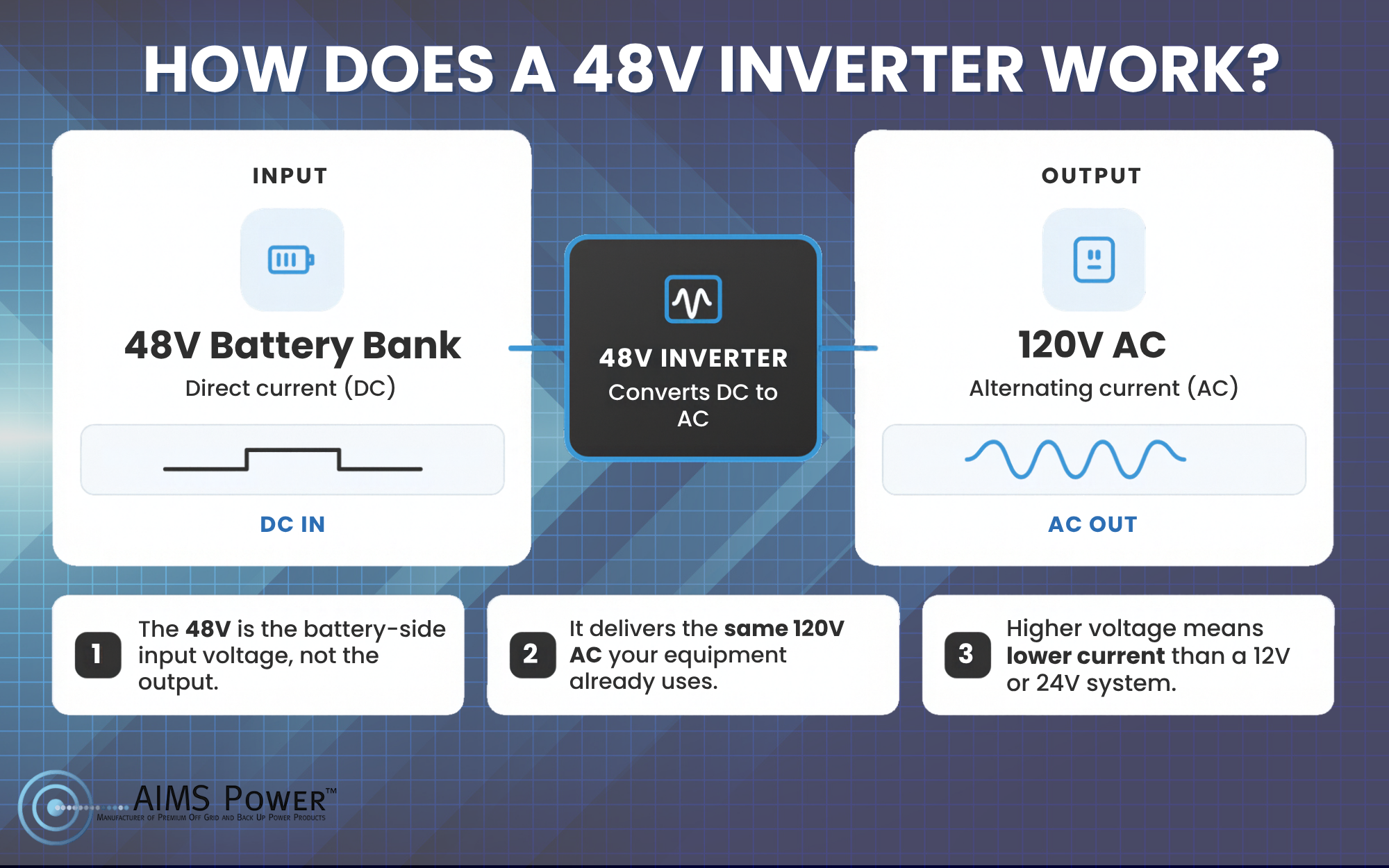
A 48V inverter is a power inverter that takes direct current from a 48-volt battery bank and turns it into alternating current, or AC power, that standard equipment expects from a wall outlet. The “48V” refers to the input voltage on the battery side. The AC output is the same 120 or 240 VAC your loads already use.
Every inverter does this DC to AC conversion. What sets 48V inverters apart is the battery voltage they draw from. Because power equals volts times amps, a system built at 48 volts carries far less current than a 12V or 24V system delivering the same wattage. Lower current is the single reason 48V has become the default for larger installations.
Why 48V for High Capacity Systems?
The advantage of 48V is not more power on its own. It is how efficiently the system moves that power. At a given wattage, higher voltage means lower current, and lower current changes almost every part of the build.
Smaller, Cheaper Cables
The amount of current flowing through a wire determines how thick the wire has to be. Higher current needs a thicker, more expensive conductor to carry it safely without overheating. Because a 48V system runs at roughly a quarter of the current of a 12V system for the same load, it needs far less copper, which lowers installation cost and makes the wiring easier to route.
Less Heat and Loss
Some of the energy moving through a cable is always lost along the way as heat, and that loss grows as the current climbs. A 12V system pushes about four times the current of a 48V system for the same load, so it gives up noticeably more energy warming the wires instead of reaching the equipment. Running at 48V lowers the current, which trims that wasted heat and keeps more of the battery’s power doing useful work.
Room to Scale
Every increase in wattage means more current, and at 12V that current climbs fast enough to become difficult to wire. High performance inverters in the 6,000 to 12,000 watt range are built for 48V because delivering that much power at 12V would call for impractically thick cables and oversized connections. Building at 48V keeps the wiring manageable and leaves room to add capacity later without redoing the whole system.
Cleaner High Draw Performance
Heavy equipment pulls a large spike of power the moment it switches on, often several times its normal running draw. A 48V platform sized with enough surge headroom absorbs those spikes more steadily, so large motors, compressors, and other surge power loads start and run without straining the system. That steadier response is a big part of why high-capacity builds lean on 48V instead of a lower voltage.
For any system built around a large battery bank and heavy loads, these advantages add up to a setup that runs cooler, costs less to wire, and holds enough headroom to grow as your power needs increase.
12V, 24V, or 48V: How Battery Voltage Shapes the System
Battery voltage is the first design choice, and it scales with system size. Small mobile and accessory systems stay at 12V, mid-size builds use 24V, and large off-grid and backup systems move to 48V.
System voltage | Typical use | Current at 5,000W | Best fit |
12V | RVs, small mobile, accessories | ~417A | Small loads, single batteries |
24V | Mid-size RV, van, small off-grid | ~208A | Moderate loads |
48V | Whole-home backup, large off-grid, commercial | ~104A | High-capacity systems, large battery banks |
The pattern is consistent: as the load and battery bank grow, moving to a higher battery voltage keeps the current, cable size, and heat under control. At the top of that range, 48V is what keeps a high capacity system practical to build and safe to run.
Key Features to Look for in a 48V Inverter
Not every 48V inverter is built for the same job. These are the specs that decide whether a unit fits a high-capacity off-grid or backup system.
Pure Sine Wave Output
A pure sine wave inverter produces AC power with total harmonic distortion under 3%, matching grid quality. That clean pure sine wave output is what sensitive electronics, motors, and medical equipment need to run without overheating or faulting. For any serious backup or off-grid build, pure sine is the standard, not modified sine.
Split-Phase 120/140V Output
Large systems usually need 240V for well pumps, HVAC, and other heavy loads, not just 120V outlets. A split-phase inverter delivers both 120V and 240V from one unit, which is why split-phase 48V inverters are common in whole-home backup and commercial off-grid. If your build has any 240V load, a phase inverter with true split phase output is the piece that runs it.
Built-In Charging and Solar Input
Many 48V units are inverter chargers, combining the inverter and a smart battery charger in one unit. That charger accepts AC input from the grid or a generator to top the battery bank. An all-in-one inverter goes further, folding in a solar charge controller with PV input, the solar input, so solar panels feed the battery bank directly. In that form, the unit works as a 48V solar inverter: a solar charger by day, inverter power on demand, and grid or generator charging as backup. Protection and Monitoring
A 48V inverter built for demanding use includes layered protection: temperature protection, short-circuit and overload protection, and an integrated circuit breaker on the AC side. Many units add a remote control panel and Bluetooth monitoring so you can track input voltage, output, and battery state in real time. These features are what keep a high-capacity system safe and easy to service.
Where 48V Inverters Fit
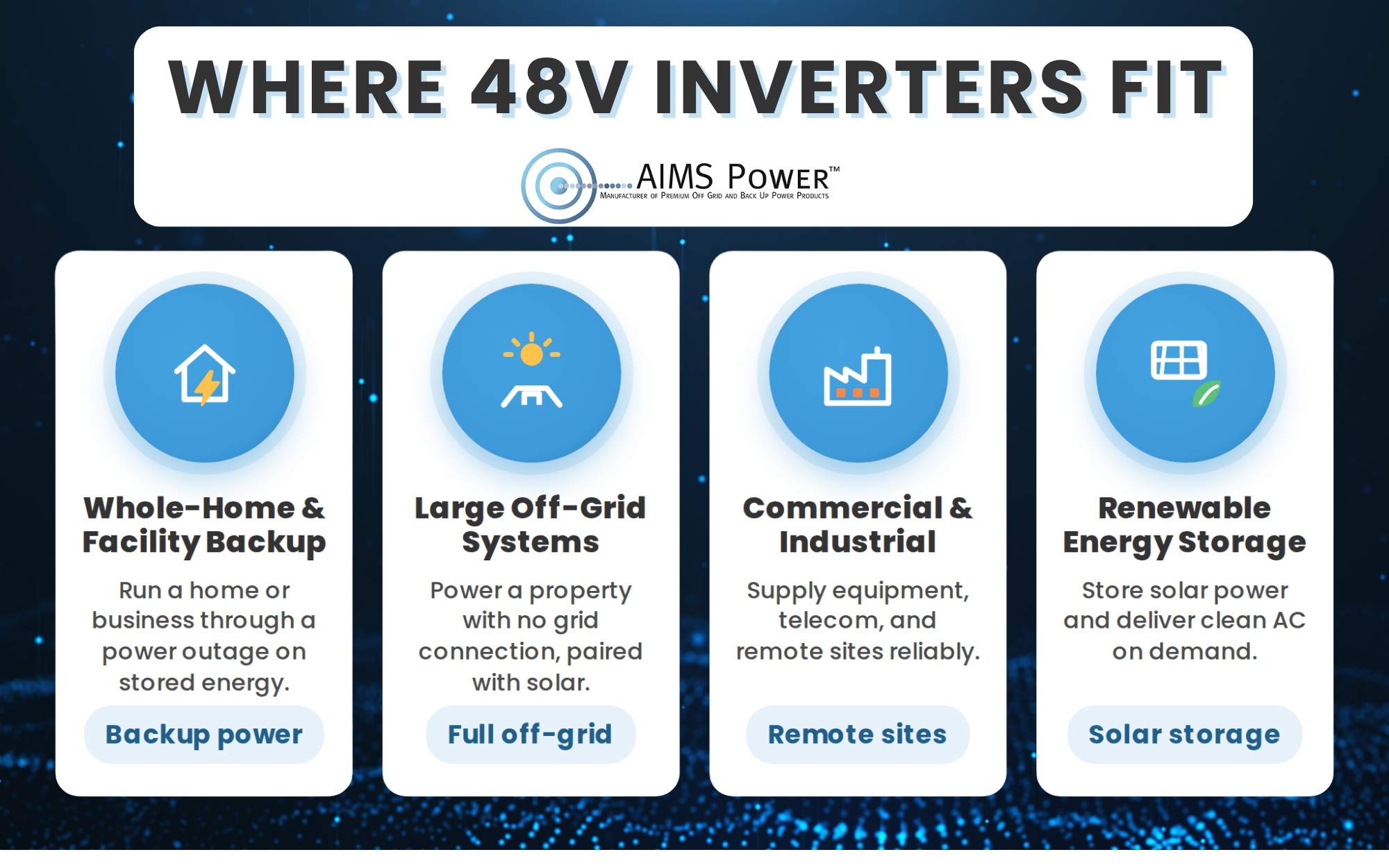
48V inverters show up wherever a system has to move serious power reliably.
- Whole-home and facility backup: Running a home or business through a power outage on stored energy, with a split-phase inverter covering both 120V and 240V loads.
- Large off-grid systems: Powering a property with no grid connection, paired with a big battery bank, solar panels, and a solar charge controller for full energy independence.
- Commercial and industrial: Supplying reliable power to equipment, telecom, and remote sites where a low-voltage system would need impractical wiring.
- Renewable energy storage: Storing solar power in a 48V battery bank and delivering clean AC power on demand as a solar generator.
In each case, 48V is what lets the system carry a heavy, sustained load without oversized cables or excess heat.
Build Your 48V System With AIMS Power
AIMS Power is a U.S. based manufacturer with more than 25 years of experience building power conversion and renewable energy equipment, backed by in-house technical support available every business day. AIMS builds the full 48V side of a high-capacity system for installers, dealers, OEMs, and businesses specing power into a facility or a product; that means one source for matched components and the technical help to size them to the load.
If you are building a high capacity off-grid or backup system, browse the full line of AIMS Power 48V inverters to match the output and features to your load, or contact AIMS Power to talk through a system, an OEM program, or volume options.