Portable Generator vs. Inverter System: Choosing Reliable Backup Power
The Short Answer: A portable generator makes AC power by burning fuel to run an engine, so it keeps producing energy as long as you feed it gasoline, propane, or diesel. An inverter system makes AC power by pulling from a battery bank, so it runs silently with no fuel and no emissions until the batteries drain, then recharges from solar, shore power, or a generator.
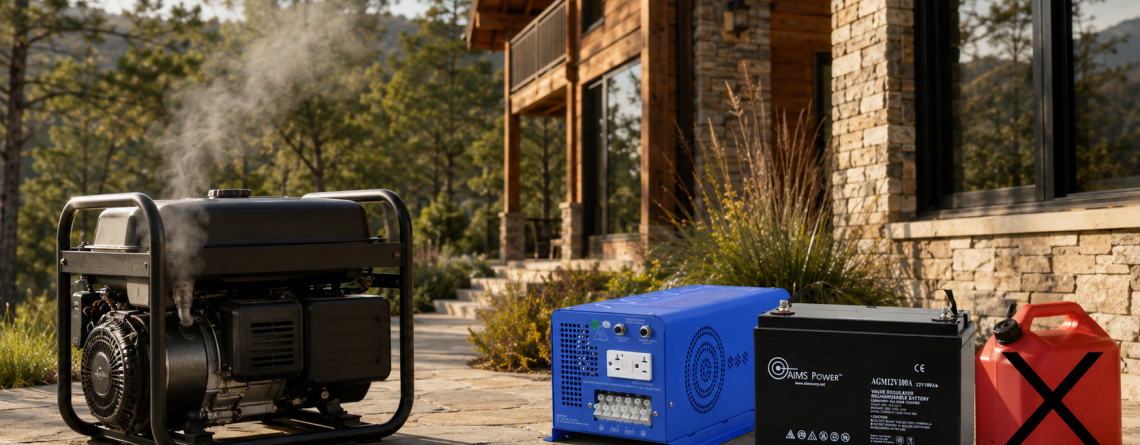
When grid power fails, whether from a storm, an overloaded line, or planned maintenance, a business needs a backup source that fits the job in front of it. A portable generator and a battery-based inverter system both deliver backup power, but they work in different ways, and each suits a unique set of conditions. Knowing how each one produces power, what it costs to run, and where it performs best is what separates a backup plan that holds up from one that leaves equipment down at the worst time.
How a Portable Generator Makes Power
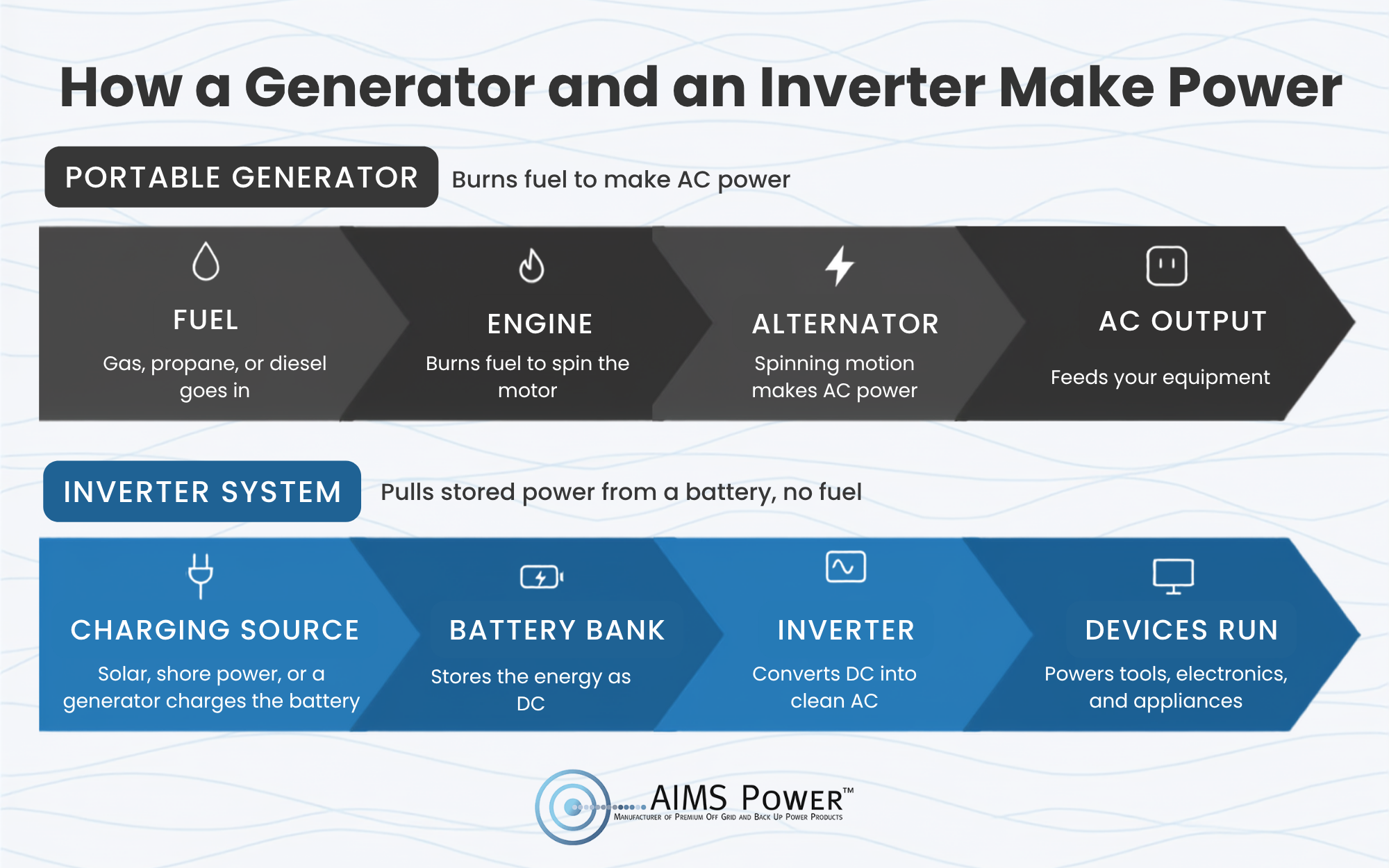
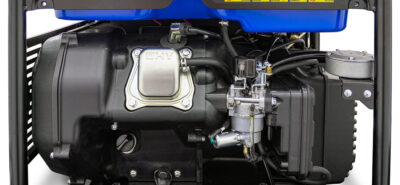
The engine converts fuel into mechanical energy, and the alternator turns that mechanical energy into electrical energy. A generator burns fuel to turn an engine, and that engine spins an alternator that produces AC power. How the unit manages engine speed is what splits generators into two types.
Conventional Generators
A conventional generator, sometimes called a traditional or regular generator, runs its engine at a constant speed, usually around 3,600 rpm, to hold a steady 60 Hz output. The engine holds that speed no matter how light the load is, which raises fuel consumption at low draw and pushes up the noise level. The electrical output also carries more total harmonic distortion, often well above 5%, which is acceptable for a construction site running power tools but rough on more sensitive electronics.
Inverter Generators
An inverter generator still burns fuel, but it converts the engine’s raw output to DC and then back to clean AC through an inverter. This lets the engine adjust its speed to match power demand instead of holding a constant speed, which improves fuel efficiency and reduces noise. Many inverter models offer dual fuel operation and electric start. They deliver cleaner power than a conventional unit, though they cost more up front and top out at a lower power output than large conventional gasoline generators.
How an Inverter System Makes Power
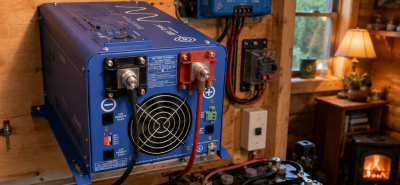
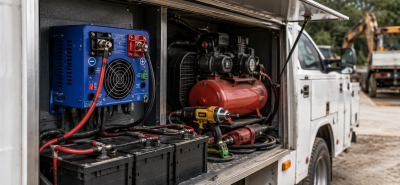
An inverter system stores energy in a battery bank and uses an inverter to turn that DC into AC power on demand. Because a battery-based inverter system does not use a combustion engine, it produces no direct exhaust emissions during operation, runs quietly, and can be installed indoors when the equipment is designed and installed for indoor use. A pure sine wave inverter produces clean power with total harmonic distortion under 3%, similar quality to grid power, which is what sensitive electronic devices and medical equipment need to run safely.
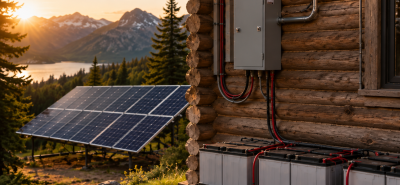
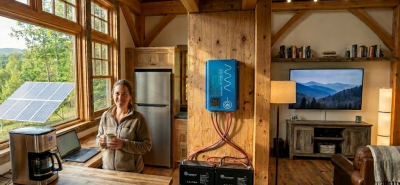
Runtime depends on battery capacity instead of a fuel tank. When the batteries drain, they recharge from solar panels, shore power, or a generator. Pairing the inverter with solar creates what many call a solar generator, a setup that recharges during daylight and can extend backup power for days without buying fuel. Because the system only draws from the battery when a load is present, it wastes nothing sitting idle, which is better than an engine burning fuel to produce power no one is using.
Inverter System vs. Portable Generator, Side by Side
The easiest way to compare the two is by how they behave during an actual power outage.
Inverter System | Portable Generator | |
Power quality | Pure sine, THD under 3% | Clean on inverter type, higher THD on conventional |
Noise level | Silent | Loud to moderate |
Emissions | None, safe to run indoors | Carbon monoxide, run outdoors only |
Maintenance | Minimal, no engine | Regular engine and fuel service |
Running cost | No fuel, lower over time | Ongoing fuel plus upkeep |
Runtime | Until batteries drain, then recharge | As long as fuel is available |
Best for | Clean power, indoor and quiet sites, frequent outages | Long remote outages with high draw |
Matching Backup Power to the Application
The right choice comes down to the conditions of the job, not the spec sheet alone. Where the system runs, what it powers, and how long it needs to hold up all shift the decision.
When an Inverter System Fits
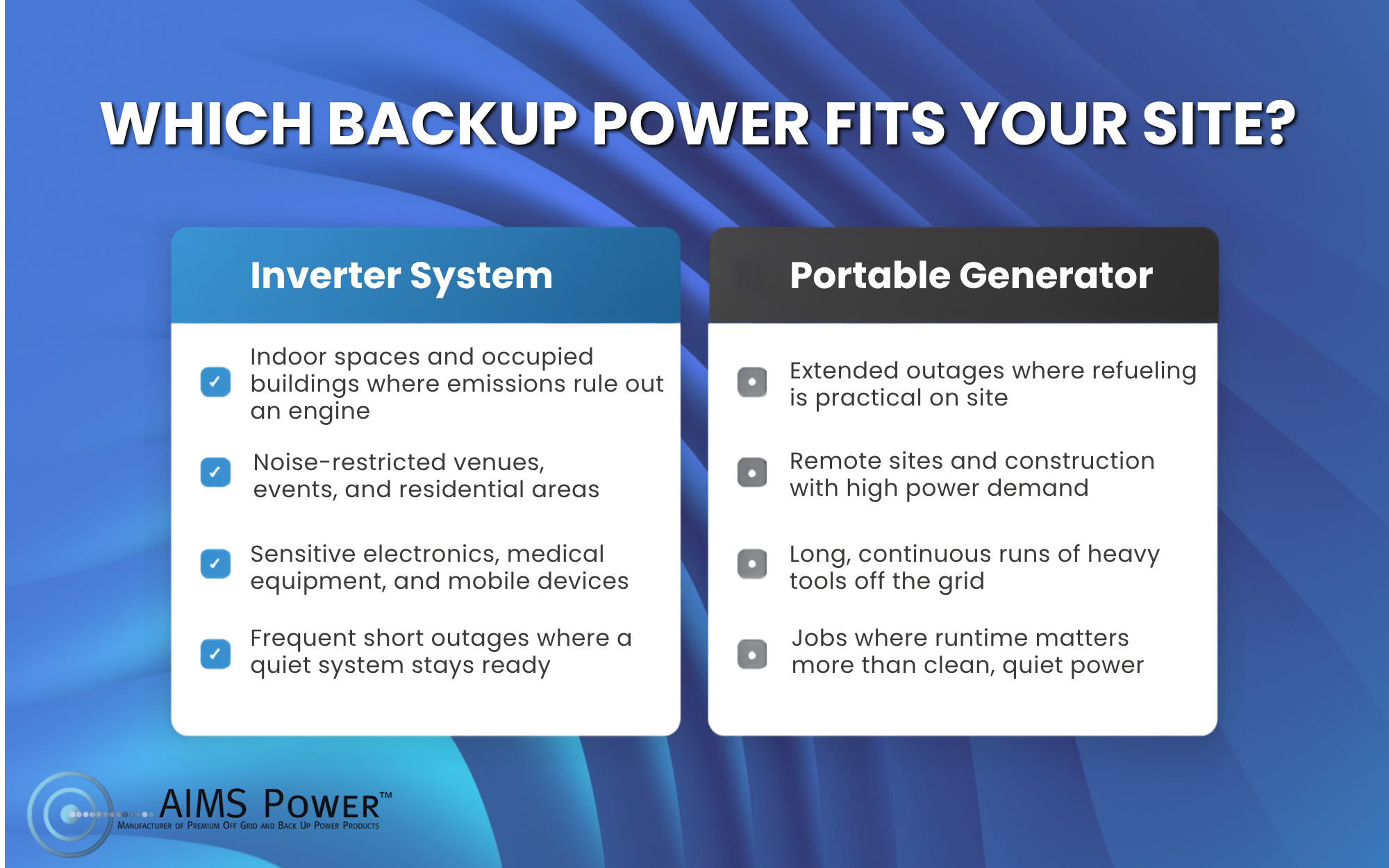
- Indoor spaces, occupied buildings, and any site where carbon monoxide rules out an engine.
- Noise-restricted venues, outdoor events, and residential areas that limit generator use.
- Equipment that needs stable power, including sensitive electronics, medical equipment, and mobile devices that fault on a dirty waveform.
- Operations that face frequent short outages, where a quiet system that is always ready beats pulling out a generator every time.
An inverter system paired with a battery bank and solar also works as a standby power source that stays ready without the regular maintenance an engine requires. For a lot of businesses, that covers the majority of what backup power actually has to do.
When a Portable Generator Fits
- Extended outages where refueling is practical, and fuel is easy to store on site.
- Remote job sites running heavy equipment for long stretches, where the draw outpaces what solar can put back during the day.
- Short winter days, heavy shade, or long overcast stretches, where solar cannot recharge a battery bank fast enough to stay ahead of the load.
- Long, continuous runs of heavy tools where noise is not restricted.
A generator’s strength is fuel-fed runtime, which is hard to beat for multi-day work far from the grid. Where that runtime is the priority and clean power is not, it remains the practical pick.
What Backup Power Costs to Run
Purchase price is only part of the picture. A generator carries ongoing fuel costs that rise and fall with runtime and fuel prices, plus oil changes, filters, and other regular maintenance to keep the engine reliable.
An inverter system usually costs more upfront, but it burns no fuel and needs little upkeep, and adding solar panels lowers the long-term cost further by recharging at no cost during the day. For a business that faces frequent outages, the inverter system’s lower running cost tends to close the gap after a few seasons and then continue the savings after that.
Build Your Backup Power System With AIMS Power
AIMS Power is a U.S.-based manufacturer with more than 25 years building power conversion and renewable energy equipment, backed by in-house technical support. For businesses that want clean, quiet backup power without fuel, AIMS builds the full battery-based side of the system: pure sine wave inverters for clean AC output, inverter chargers that combine inversion and battery charging in one unit, deep cycle batteries for storage, and hybrid inverters that fold solar and grid management together.
If you are specifying backup power for a facility, a fleet, or a product you build, contact AIMS Power to size the right system or to talk through OEM and reseller options. To see the equipment first, browse the full line of AIMS Power inverters and start matching the output to your load.